
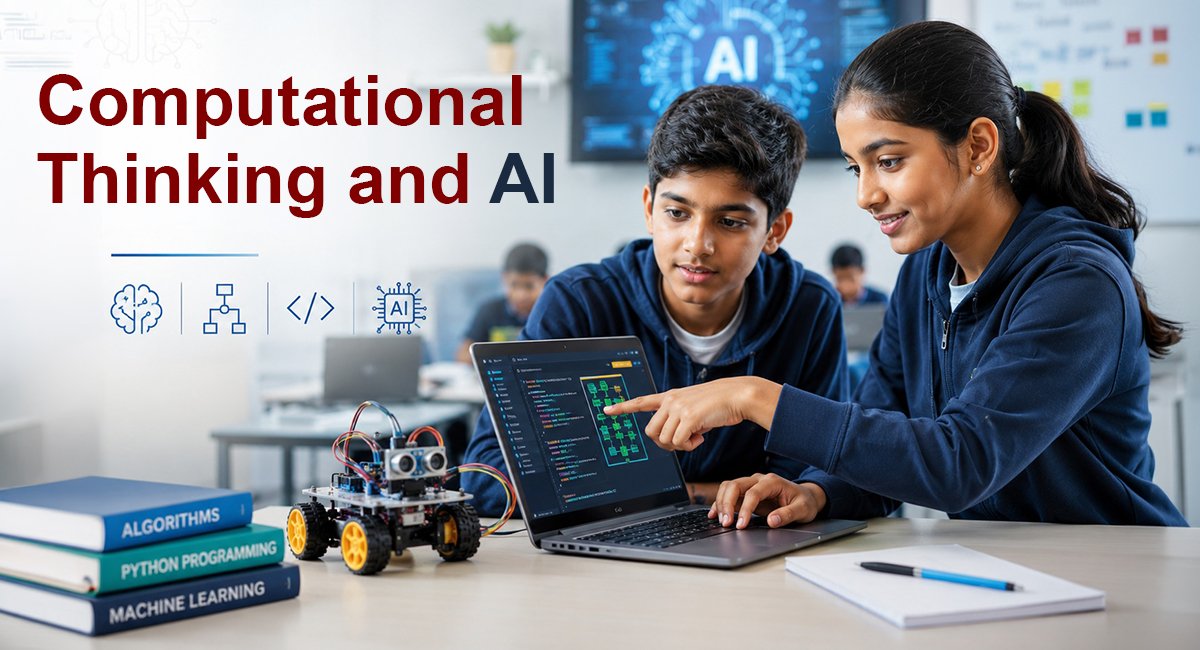
Computational Thinking and AI
“Computational thinking - is it a brand-new skill, or have you actually been practicing it every day?”
Imagine it’s the start of a new term. You’re designing timetables for multiple grades, ensuring every subject gets fair attention, teachers have balanced schedules, and students have a balanced mix of academics, arts, and physical activity. To do this, you decompose the complex task into smaller steps - allocating periods, planning teacher schedules, and coordinating resources. You use pattern recognition to spot trends in previous attendance, student engagement, and exam schedules. You apply abstraction to focus on essential factors like student learning outcomes, rather than getting lost in minor details. And you employ algorithmic thinking to create step-by-step plans that can adapt when unexpected events occur. Essentially, you’re practicing computational thinking in real life. Now imagine AI tools helping you predict which students may need extra support, or suggesting which lessons could be more interactive. That’s computational thinking and AI working hand in hand in modern schools.
Technology is reshaping education. From interactive tablets to AI-powered learning platforms, students today are learning in ways that were unimaginable a decade ago. Yet, the core skill that remains vital is the ability to think logically, solve problems, and adapt. This is where computational thinking in education comes into play, forming the foundation upon which AI can effectively enhance learning experiences.
What Is Computational Thinking?
Computational thinking is a problem-solving process that teaches students to approach challenges methodically. It involves breaking down complex tasks into smaller, manageable parts, recognizing patterns, developing step-by-step solutions, and thinking logically. This skill isn’t limited to coding or computer science—it is about learning to think like a problem-solver.
For example, when a student is preparing for a science fair project, they start by breaking down the project into smaller tasks—researching the topic, gathering materials, conducting experiments, and presenting results. They use pattern recognition to observe trends in their experimental data and notice which steps lead to success. They apply abstraction by focusing on key variables instead of getting lost in unnecessary details, and they follow algorithmic thinking by planning each experiment step carefully. This is computational thinking in action, helping the student solve a complex problem systematically.
Why Computational Thinking Matters for Students
Computational thinking for kids is important because it strengthens skills that extend far beyond technology. It nurtures:
-
Creativity: By exploring multiple solutions to a problem, students learn to think outside the box
-
Decision-making: Logical reasoning helps students weigh options and choose the best course of action
-
Analytical thinking: Students develop the ability to interpret data, spot patterns, and make informed conclusions
-
Problem-solving abilities: Step-by-step strategies make complex problems approachable and solvable
These skills are not just useful for programming - they enhance learning in mathematics, science, language arts, and even daily decision-making
Computational Thinking for Kids in Everyday Learning
Children often use computational thinking naturally. Some everyday examples include:
-
Organizing tasks: Planning the steps to complete a craft project or homework assignment
-
Solving puzzles: Identifying patterns, testing strategies, and adjusting approaches when something doesn’t fit
-
Following instructions: Baking a cake or building a LEGO model requires step-by-step logical thinking
-
Making decisions: Choosing the fastest route to school or deciding how to split time between study and play
By encouraging children to notice patterns and think methodically, educators help strengthen skills that are crucial for success in an increasingly digital world
The Growing Role of AI in Education
AI in schools is transforming traditional classrooms. It goes beyond teaching coding; AI tools are now integral to everyday learning experiences. From adapting lesson plans to providing immediate feedback, AI allows teachers to focus on creativity, collaboration, and critical thinking, while students receive a more personalized learning experience
Artificial intelligence in education is practical, not futuristic. For instance, AI-powered reading programs can suggest stories suited to a child’s reading level. Math apps can identify areas where a student struggles and offer targeted practice. This integration makes learning more efficient, engaging, and tailored to individual needs
How AI Is Supporting Personalized Learning
One of the most significant benefits of AI learning for students is personalization. AI tools analyze how students learn and adapt lessons to suit their pace and preferences. Examples include:
-
Offering easier or more challenging problems based on performance
-
Recommending topics that need revision
-
Providing visual or interactive learning formats for different learning styles
This level of personalization ensures students are neither bored with too-simple content nor overwhelmed with too-challenging tasks. Personalized learning encourages deeper understanding and sustained interest
AI in Schools Beyond Technology Classes
AI is no longer confined to computer science classes. It is integrated into various subjects and school operations:
-
Classroom activities: AI can suggest interactive experiments, simulations, or games that reinforce lesson objectives
-
Assessments: AI-driven quizzes can evaluate student performance and provide detailed insights
-
School management: AI tools can help with scheduling, tracking attendance, or predicting areas where students may need extra support
By embedding AI across the school environment, students develop familiarity with these technologies while learning core subjects effectively.For more insights, explore AI in education.
How Computational Thinking and AI Work Together
Computational thinking provides the foundation for understanding AI. Logical reasoning, decomposition, and pattern recognition help students grasp how AI models work, even if they don’t program them. By combining computational thinking and AI, students learn not just to use AI, but to understand, question, and innovate with it.
Preparing Students for Future Careers
The future workforce will require skills that blend human creativity with AI understanding. Careers in fields like data analytics, healthcare, environmental sciences, and engineering increasingly demand:
-
Digital literacy
-
Critical thinking
-
Adaptability
-
Awareness of AI applications
By fostering computational thinking and introducing AI learning early, schools prepare students to thrive in diverse, tech-driven industries
Encouraging Innovation and Creativity
AI is a powerful tool for creativity, but computational thinking ensures students use it responsibly and effectively. For example:
-
Students might use AI to generate story ideas, but computational thinking helps them structure plots and develop characters logically.
-
AI can assist in designing experiments, while structured problem-solving guides the analysis and interpretation of results
This combination encourages independent thinking, evaluation of information, and innovative problem-solving.
Benefits of Introducing AI Learning at an Early Age
Introducing AI concepts early offers numerous developmental and educational benefits:
-
Familiarity with technology
-
Improved problem-solving and decision-making
-
Enhanced curiosity and experimentation
-
Development of collaboration and teamwork skills
Early exposure demystifies technology, helping students embrace future learning opportunities confidently.
Building Confidence With Technology
When students interact with AI tools from a young age, they develop comfort and confidence in using digital resources. This reduces anxiety around technology, encourages experimentation, and helps students approach challenges with a growth mindset. By integrating AI learning naturally into classrooms, educators equip students to use tools responsibly and independently.
Improving Problem-Solving and Collaboration Skills
AI learning often involves interactive activities, group projects, and guided experimentation. These experiences foster teamwork, logical thinking, and critical analysis.
For example:
-
Collaborative AI projects in math can involve building models to predict outcomes
-
Language arts tasks can use AI for generating prompts while students critically review and improve content
Such activities teach children to communicate ideas clearly, iterate on solutions, and respect diverse perspectives
The Role of Schools and Educators
Schools play a crucial role in balancing AI learning for students with creativity, ethics, and human interaction.
Educators can:
-
Integrate AI into lessons thoughtfully, not just as a novelty
-
Encourage hands-on problem-solving, experimentation, and reflection
-
Promote ethical use of AI and discuss its societal implications
-
Create a safe, inclusive environment for tech-based and traditional learning
By combining technology with human-centered teaching, schools cultivate future-ready students who are confident, innovative, and responsible
Conclusion
In today’s rapidly evolving educational landscape, computational thinking and AI are more than technical skills—they are essential life skills. They empower students to think critically, solve problems methodically, and adapt to change. Artificial intelligence in education supports personalized learning, creativity, and collaboration, making education more engaging and effective. By fostering these skills early, schools prepare students not just for technology careers, but for thoughtful, innovative participation in a complex, digital world.
