
From Rote to Real: The Shift in Education
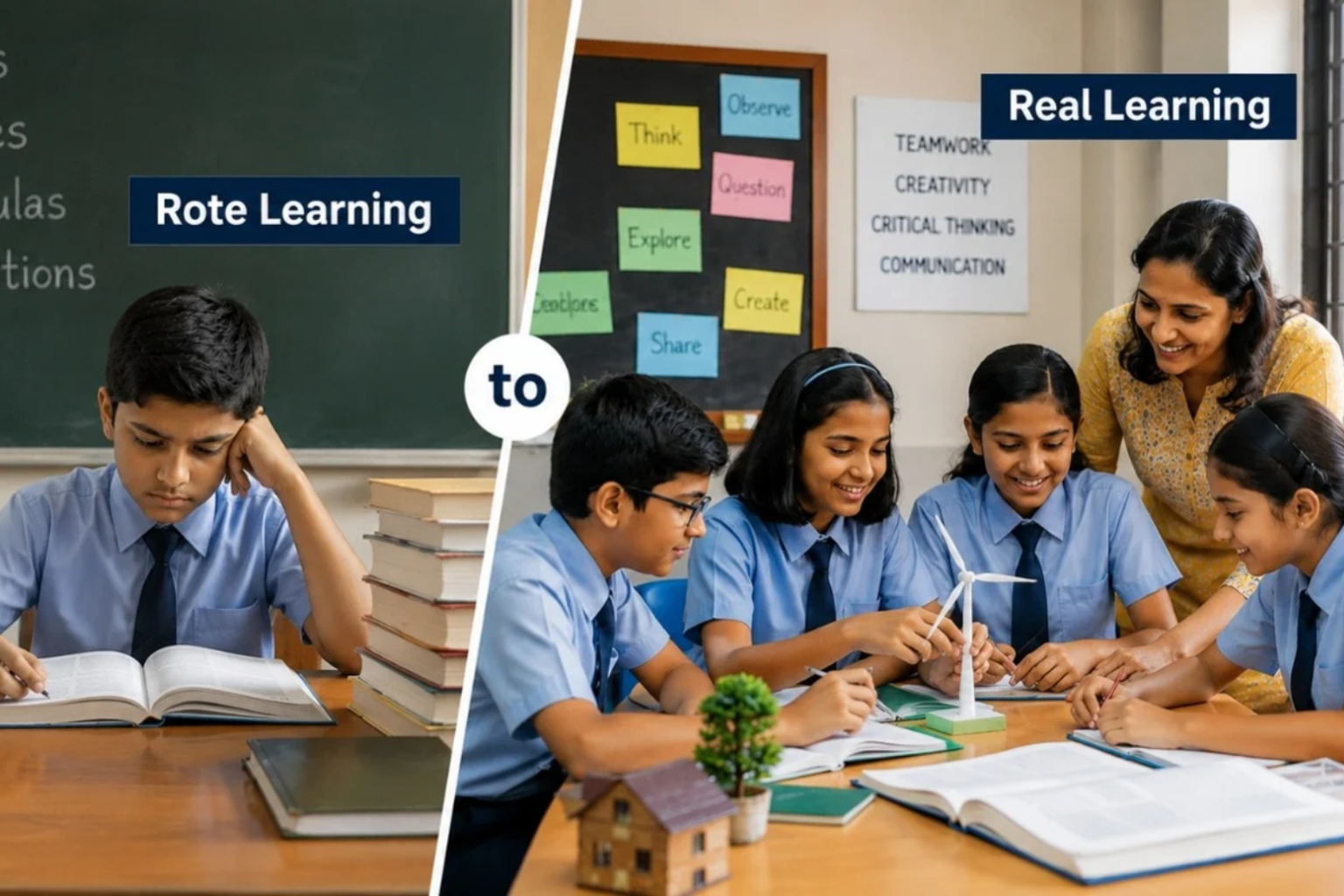
For generations, education was often associated with memorising facts, reproducing information in examinations, and progressing through the academic system. While memorisation continues to play an important role in building foundational knowledge, the demands of today’s world have transformed what students need to learn and how they learn it
Success today requires more than remembering information. Students must be able to understand concepts, apply knowledge in different situations, solve problems, communicate effectively, collaborate with others, and adapt to change. As a result, schools across India are gradually moving from an education model centred primarily on recall to one that emphasises understanding, application, and skill development
This shift has given rise to experiential learning, competency-based education, and student-centered learning, all of which aim to create meaningful learning experiences while supporting holistic education and future-ready education
Why Traditional Rote Learning Is No Longer Enough
Rote learning has long been a familiar part of education. Memorising multiplication tables, vocabulary, formulas, and key concepts helps students build strong academic foundations. However, remembering information alone does not always guarantee understanding. A student may be able to define a concept accurately yet struggle to explain its relevance or apply it in a new situation. In an increasingly complex world, learners must be able to think critically, make connections, and use their knowledge effectively
The Gap Between Knowledge and Application
One of the biggest limitations of rote learning is the gap between knowing and doing
Students may perform well in assessments that focus on recall but find it difficult to apply the same concepts in practical situations. For example, a learner may memorise mathematical formulas yet struggle to determine when and how to use them to solve everyday problems
Modern education seeks to bridge this gap by encouraging students to understand concepts deeply and apply them confidently
Changing Expectations From Schools
Parents today expect schools to prepare children not only for examinations but also for life beyond the classroom. Higher education institutions and employers increasingly value communication, collaboration, creativity, problem-solving, and adaptability alongside academic achievement
As expectations evolve, schools are recognising the need to provide learning experiences that help students develop both knowledge and essential life skills
The Rise of the Modern Education System
The modern education system focuses on developing competencies rather than simply covering content. Learning is designed to help students understand concepts, apply knowledge, develop skills, and grow as individuals
This approach aligns closely with the vision of the National Education Policy (NEP) 2020, which encourages a shift towards conceptual understanding, competency development, and holistic growth
Learning Beyond Textbooks
Textbooks remain an important part of learning, but they are no longer the sole focus of classroom instruction.
Students today are increasingly engaged through discussions, activities, experiments, observations, presentations, projects, simple research tasks, and collaborative learning experiences. Rather than simply learning about concepts, they are encouraged to interact with them, ask questions, investigate ideas, and apply their understanding in meaningful ways
For instance, instead of only memorising the stages of plant growth, students may observe a plant over time and record the changes they notice. While learning measurement, they may compare classroom objects and estimate distances using mathematical concepts. Such experiences help strengthen understanding and make learning more meaningful
Preparing Students for Future Success
The future will require individuals who can continue learning, adapt to new situations, and work effectively with others. Schools therefore focus on developing skills such as communication, collaboration, critical thinking, digital literacy, and responsible decision-making alongside academic knowledge
The skills required for success are also evolving. Alongside literacy and numeracy, students are increasingly encouraged to develop computational thinking skills such as pattern recognition, logical reasoning, problem decomposition, and structured problem-solving. As emerging technologies, including Artificial Intelligence, become part of everyday life, these abilities help learners analyse information critically, make informed decisions, and adapt confidently to a changing world
Does Moving Beyond Rote Learning Affect Academic Performance?
One concern often raised by parents is whether a greater focus on experiential and student-centered learning affects examination performance
In reality, the goal is not to reduce academic rigour but to strengthen it. This shift is also reflected in assessment practices. CBSE has progressively increased the emphasis on competency-based questions that assess application, analysis, and problem-solving rather than simple recall. As a result, conceptual understanding is becoming increasingly important for academic success
How Experiential Learning Creates Meaningful Learning Experiences
Experiential learning is based on a simple principle: students learn more effectively when they actively engage with what they are learning
Rather than receiving information passively, learners participate in activities that encourage exploration, observation, reflection, and application
Depending on the age group and learning objectives, experiential learning may include projects, experiments, field visits, simulations, observations, and hands-on activities that encourage students to connect classroom learning with real-world experiences
Improving Student Engagement
Students are naturally more engaged when they take an active role in the learning process. Activities, experiments, discussions, and hands-on experiences encourage curiosity and participation
When learners are involved in discovering concepts rather than merely memorising them, learning often becomes more enjoyable and meaningful
Connecting Classroom Learning to Real Life
Experiential learning helps students understand why concepts matter.
For example, a science experiment allows learners to observe principles in action, while a classroom activity involving measurement helps them understand how mathematics is used in everyday situations
Such experiences can help students build confidence, deepen conceptual understanding, and become more comfortable applying their learning in unfamiliar situations
Why Competency-Based Education Is Shaping the Future
Competency-based education focuses on what students can do with their learning rather than simply what they can remember.
The emphasis shifts from completing content to demonstrating understanding, application, and mastery of concepts and skills.
Measuring Understanding Over Memorisation
Modern assessments increasingly evaluate how well students can apply knowledge, analyse information, solve problems, and explain their thinking.
This approach provides a more complete picture of learning and encourages deeper engagement with concepts
Supporting Diverse Learning Needs
Every child learns differently. Some students learn best through observation, while others benefit from discussion, practice, or hands-on experiences
Competency-based education recognises these differences and provides multiple opportunities for learners to demonstrate understanding while maintaining clear learning expectations
The Growing Importance of Student-Centered Learning
Student-centered learning places learners at the heart of the educational experience. Rather than being passive recipients of information, students actively participate in the learning process.
They are encouraged to ask questions, explore ideas, reflect on their learning, and contribute to classroom discussions
Encouraging Ownership of Learning
When students are given opportunities to make choices, set goals, and take responsibility for their progress, they become more invested in learning
This sense of ownership can improve engagement, confidence, and motivation.
Building Independent Thinkers
Student-centered learning helps develop critical thinking, decision-making, and self-reflection.
These skills enable students to approach challenges thoughtfully, evaluate information independently, and become lifelong learners
Holistic Education and Future-Ready Learners
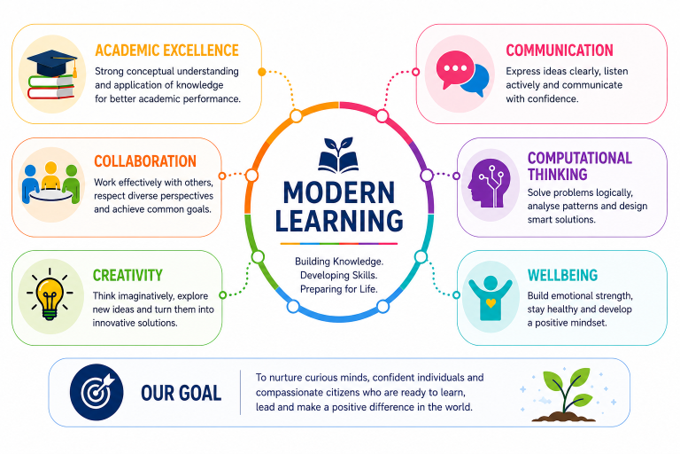
Education extends beyond academic achievement. Holistic education focuses on the intellectual, emotional, social, physical, and ethical development of every learner
This approach recognises that success in life depends on more than examination scores alone
The Outcome of Meaningful Learning
Students who learn through understanding, application, and reflection often develop:
- Stronger conceptual understanding
- Greater confidence
- Better communication skills
- Improved problem-solving abilities
- Readiness for academic and real-world challenges
Developing Essential Life Skills
Students need opportunities to develop communication, collaboration, leadership, resilience, empathy, emotional intelligence, and responsible decision-making
These skills help learners build healthy relationships, navigate challenges, and contribute positively to society
Creating Well-Rounded Individuals
Schools today increasingly focus on nurturing the whole child. Alongside academic excellence, equal importance is given to character development, wellbeing, values, creativity, and personal growth
The objective is to help students become confident, compassionate, and responsible individuals who are prepared for the opportunities and responsibilities of the future
The Role of Technology in Supporting Modern Learning
Technology continues to play an important role in supporting modern learning environments. It enables personalised learning experiences, improves accessibility, encourages collaboration, and provides opportunities for interactive engagement
When used purposefully, digital tools can support different learning needs while helping students explore concepts in engaging ways. From interactive content to personalised learning pathways, technology helps make learning more engaging and accessible for students. As educational practices continue to evolve, it is increasingly clear that technology makes learning more effective
What This Educational Shift Means for School Leaders
Successfully moving from rote learning to meaningful learning requires thoughtful leadership. Teachers, principals, and school directors play a vital role in creating environments where students can develop both academic excellence and essential life skills
This includes adopting innovative teaching practices, strengthening assessment methods, supporting teacher development, and fostering a culture of continuous improvement
What Parents Can Look For in a Learning Environment
Parents exploring schools may consider asking:
-
Are students encouraged to participate actively in learning?
-
Does teaching go beyond memorisation to promote understanding and application?
-
Are assessments designed to evaluate understanding as well as recall?
-
Are communication, collaboration, and leadership skills actively developed?
-
Does the school focus on both academic achievement and overall student growth?
These indicators can help parents identify learning environments that support meaningful and balanced development
Conclusion
The shift from rote learning to experiential learning, competency-based education, and student-centered learning reflects a broader understanding of what education should achieve in today's world.
While memorisation continues to support foundational learning, students also need opportunities to understand, apply, analyse, and extend their knowledge. Equally important is the development of life skills, emotional intelligence, confidence, communication skills, and character
As classrooms evolve, the focus is increasingly moving towards creating meaningful learning experiences that prepare students for both academic success and life beyond school. This approach not only supports stronger conceptual understanding but also helps learners become adaptable, confident, and capable individuals who can thrive in a rapidly changing world
The modern education system is no longer focused solely on what students know, but on how effectively they can use that knowledge. By embracing holistic education and future-ready education, schools can help students perform strongly in assessments while developing the skills and mindset needed for long-term success
As parents choose schools for their children, looking for institutions that combine strong academics with meaningful learning experiences can make a significant difference in preparing them not just for examinations, but for life
