

How to Choose the Right School for Your Child in 2026
What if the school you choose today quietly shapes the person your child becomes tomorrow?
Not just their marks but their confidence, friendships, curiosity, and even how they handle challenges in life. That’s why so many parents find themselves wondering how to choose the right school for their child. It’s not just a decision but it’s a responsibility that feels both exciting and overwhelming
In 2026, the options are wider than ever. Schools offer global curricula, smart classrooms, and endless activities. But with so many choices, how do you know which one is truly right?
This guide will help you look beyond brochures and rankings, and make a decision that genuinely fits your child and not just the trend
Today’s schools are no longer just places where children memorize and write exams. They are spaces where children:
The school you choose will influence not just academic results, but how your child thinks, communicates, and adapts in the real world.
Understanding Your Child Before Choosing a School
Before comparing schools, take a step back. The most important question is not “Which is the best school?” It is “What kind of environment will help my child thrive?”
Every child is unique, with their own pace, interests, and way of learning. Some children enjoy structure and clear guidance, while others need space to explore and express themselves. Observing how your child responds to different situations - whether they are curious, shy, hands-on, or reflective - can give you valuable clues. When you understand your child better, choosing a school becomes less about trends and more about finding the right fit.
Assessing Learning Style and Personality
Every child learns in their own way. Some children understand better when they see things. Some prefer listening and discussing. Others learn best when they can try things hands-on.
Also think about personality:-
Is your child shy or expressive?
-
Do they need guidance or enjoy independence?
A school should feel like a natural extension of your child—not a place they have to struggle to fit into
Identifying Strengths, Interests, and Long-Term Goals
Sometimes, the biggest clues are in the smallest moments. Notice what your child enjoys doing - even when no one is asking them to
It could be:-
Drawing, music, or storytelling
-
Building, experimenting, or questioning
-
Playing sports or leading group activities
Schools that encourage these interests help children grow with confidence. That’s why how to select the best school for your child is really about choosing a place that sees and supports your child’s potential
Factors to Consider When Choosing a School
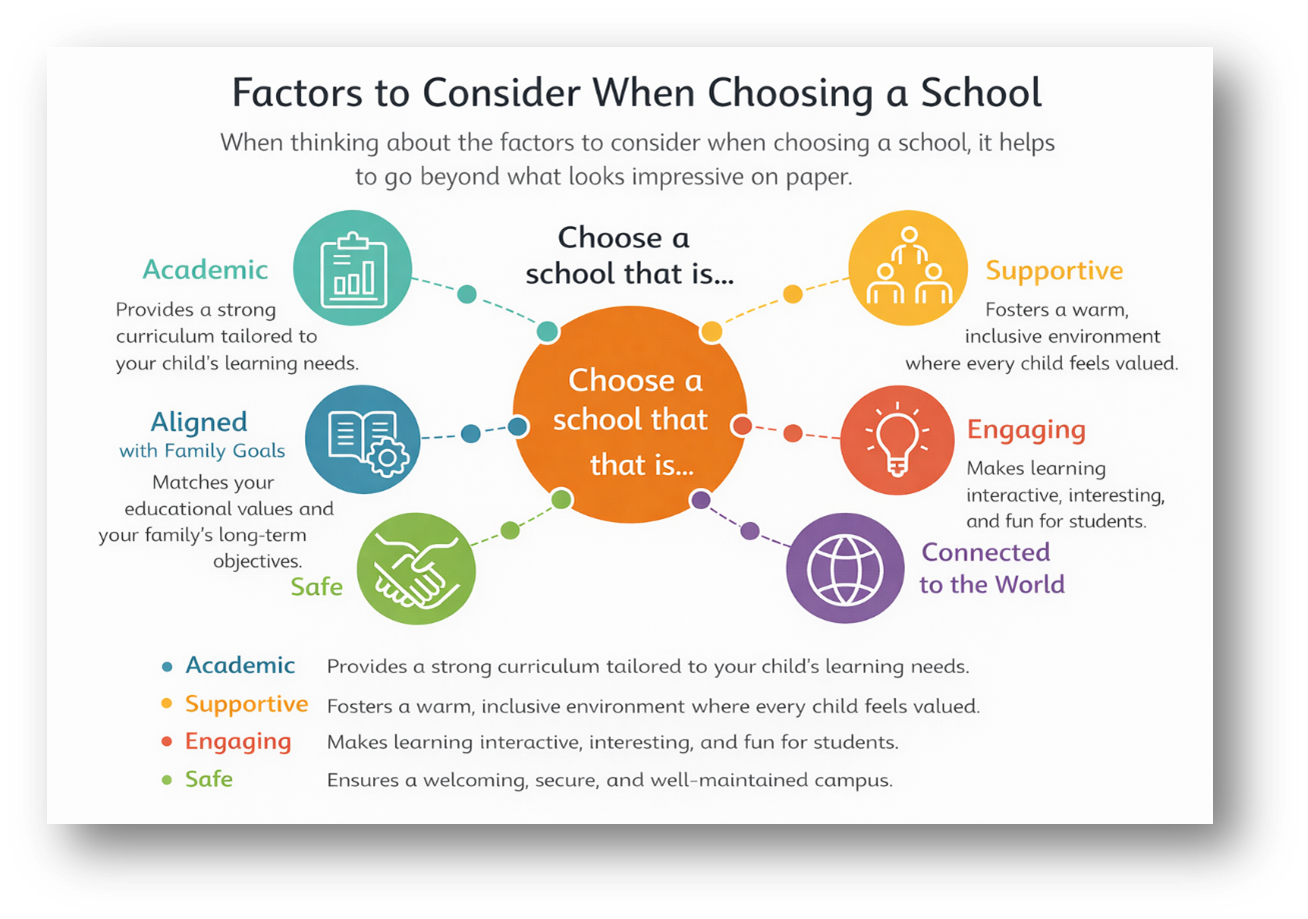
When thinking about the factors to consider when choosing a school, it helps to go beyond what looks impressive on paper
The diagram below provides a simple representation of the key factors to consider when choosing a school
Curriculum and Academic Framework
Before finalizing a school, it’s important to understand the different curricula available and how they shape your child’s learning journey. Each board has its own approach, strengths, and future pathways, so comparing them can help you make a more informed decision. The table below gives a quick overview to guide your choice.
| Curriculum / Board | Key Features | Best For | Alignment with Competitive Exams | Flexibility & Transitions |
|---|---|---|---|---|
| Central Board of Secondary Education (CBSE) | Structured, concept-based, standardized syllabus across India | Students aiming for consistency and strong academic foundation | High alignment with JEE, NEET, and other national exams | Easy transfer within India; widely accepted across schools |
| Council for the Indian School Certificate Examinations (ICSE) | Detailed, application-oriented, strong focus on English and internal assessments | Students who benefit from depth and balanced learning | Moderate alignment | Smooth transition within ICSE/ISC; slightly less flexible than CBSE |
| International Baccalaureate (IB) | Inquiry-based, research-driven, focus on critical thinking and global perspectives | Students aiming for holistic and global education | Low direct alignment with Indian entrance exams | Highly flexible; ideal for international university pathways |
| Cambridge Assessment International Education (Cambridge) | Flexible subject choices, skill-based learning, international curriculum | Students seeking subject flexibility and global exposure | Low to moderate alignment | Easy global transitions; widely accepted worldwide |
| State Boards | Region-specific syllabus, local language integration, affordable | Students preferring regional context and affordability | Varies by state; generally lower alignment | Limited flexibility outside the state; easier within state system |
Teaching Methodology and Faculty Quality
Teaching methodology and faculty quality vary across boards and play a key role in shaping a child’s learning experience
-
SSC (State Board): Follows a largely traditional, textbook-based approach, with gradual inclusion of activity-based learning; faculty training can vary across schools
-
CBSE: Emphasizes concept-based learning with a growing focus on experiential methods; teachers undergo regular training to stay updated
-
ICSE: Focuses on detailed, application-oriented learning with strong emphasis on language and subject depth; faculty are generally well-trained
-
IB: Adopts an inquiry-based, student-centric approach; teachers act as facilitators and receive extensive professional development
-
Cambridge: Promotes flexible, skill-based learning; educators are trained to encourage independent thinking and global academic standards
Infrastructure and Learning Environment
A beautiful campus may look impressive at first glance, but what truly matters is how functional and child-friendly the space is. Well-designed learning environments - like fully equipped labs, accessible libraries, and safe play areas - directly impact how children engage with learning. Cleanliness, safety measures, and thoughtful layouts create a sense of comfort and security. When children feel physically at ease in their surroundings, they are more open, focused, and ready to learn.
School Culture and Values
School culture is something you don’t just read about—you feel it the moment you step in. Imagine walking into a school where a teacher greets students by name, children are comfortable asking questions, and classmates help each other without hesitation. You notice smiles, respect in conversations, and a sense of ease in the environment. This is where values like empathy, respect, responsibility, integrity, and teamwork are not just taught, but lived every day. Such an environment quietly shapes how children think, behave, and connect with others, helping them grow into confident and grounded individuals
Location and Accessibility
Before finalizing a school, it’s important to think about its location and how it fits into your child’s daily routine. The right location can make everyday life smoother, more balanced, and less stressful for both children and parents. Looking beyond just distance and considering overall accessibility can help you make a more practical and thoughtful choice
Here are key points parents should consider while choosing the location of a school:
-
Distance from home: A shorter distance reduces travel fatigue and saves time for rest, play, and studies
-
Travel time (not just distance): Traffic conditions can make a nearby school feel far—check actual commute time during school hours.
-
Transport availability: Reliable school transport or safe public/private options are important for daily convenience.
-
Safety of the route: Ensure the route is secure, well-connected, and not too isolated or risky for children
-
Accessibility for parents: The school should be easy to reach in case of emergencies, meetings, or school events
-
Impact on routine: Long travel hours can affect sleep, extracurricular time, and overall well-being
-
Future convenience: Consider long-term feasibility—will the commute still work as your child grows or schedules change?
Fee Structure and Transparency
Education is a long-term commitment, and financial clarity is essential to avoid stress later. It’s important to understand not just the tuition fees but also additional costs like transport, activities, and annual charges. Planning ahead for future fee increases helps you make a sustainable decision. When finances are clear and manageable, you can focus more confidently on your child’s overall growth
Evaluating Academic Performance and Reputation
While a school’s reputation can be a useful starting point, it’s important to look beyond rankings and marketing claims. Consistency in academic results over the years gives a more reliable picture of performance. It’s also helpful to understand where students go after graduating and how well they are prepared for the next stage. Speaking to other parents can provide honest insights that go beyond brochures and websites
The Importance of Extracurricular and Skill Development Programs
When you think back to your own school days, the memories that stand out are often from activities, competitions, and friendships and not just classroom lessons. Schools that offer a strong mix of sports, arts, and skill-based programs help children discover their interests and talents. Opportunities in areas like coding, robotics, leadership, and communication allow students to grow beyond academics. These experiences build confidence, creativity, and essential life skills
Technology Integration in Schools in 2026
Technology has become an integral part of modern education, from smart classrooms to AI-based learning tools that personalize student progress. When used effectively, technology can make learning more engaging and tailored to individual needs. However, the key lies in balance. The best schools use technology to enhance learning while still maintaining strong human connections and meaningful teacher-student interactions.

School Visits and Parent Interaction
No amount of online research can replace the experience of visiting a school in person. Walking through the campus gives you a real sense of the environment. Observe whether students are actively engaged, whether teachers appear approachable, and whether the overall atmosphere feels welcoming. Don’t hesitate to ask questions—transparent and open communication is often a sign of a confident and well-managed school
Comparing and Shortlisting Schools Strategically
With so many options available, it’s easy to feel overwhelmed. Instead of trying to evaluate too many schools at once, narrow down your choices to a manageable list
Given below is an easy and practical checklist parents can follow when comparing and shortlisting schools:
- Does the school’s curriculum align with my child’s future goals?
- Is the teaching approach engaging and concept-based rather than rote?
- Is the student-teacher ratio comfortable for individual attention?
- Does the school environment feel positive, safe, and supportive?
- Does the school offer a good mix of extracurricular activities?
- Are the infrastructure and facilities clean, safe, and well-maintained?
- Is the school location convenient with a manageable daily commute?
- Is the fee structure transparent and within my budget?
- Does the school use technology meaningfully in learning?
- Are parents encouraged to interact and communicate with the school
Exploring Established Education Networks
If you’re unsure where to begin, looking at established school networks can provide a sense of direction. Such institutions often follow structured systems and maintain consistent quality across campuses. For instance, networks like Birla Open Minds International School focus on balancing academic excellence with overall development, offering a more holistic approach to education
Common Mistakes Parents Make When Choosing a School
Choosing a school can feel overwhelming, and it’s very easy to get influenced by brand names, trends, or what other parents are doing. But the right choice really comes down to what works best for your child. Before you decide, pause and ask yourself:
- Am I choosing this school because it suits my child’s learning style and comfort?
- Have I looked beyond just the name and reputation?
- Does it match my child’s interests and future goals?
- Am I making this decision calmly, without pressure?
- Have I actually visited the school and understood its environment?
These simple checks can help you move away from confusion and choose with clarity and confidence
A Step-by-Step Choosing the Right School for Your Child Guide
If the process feels overwhelming, breaking it down into simple steps can help. Start by understanding your child’s needs and learning style. Explore different school options and shortlist a few that align with your priorities
Visit the shortlisted schools, observe the environment, and compare them carefully. Consider your budget and long-term plans before making a final decision. Taking it step by step makes the process more manageable and less stressful
Final Thoughts on Making the Right Choice in 2026
At the end of the day, choosing the right school isn’t about picking the most famous name or the most expensive option - it’s about finding a place where your child feels happy, understood, and excited to go every morning. And that’s what really matters, because when a child feels right in their environment, learning follows naturally and sets a strong foundation for their future.
