
Why Critical Thinking Is an Essential Student Skill
Arjun stared at three different answers to the same question—one from his textbook, another from a website, and a third from his class group chat. Each sounded convincing, but they couldn’t all be right. In that moment, he realised the real challenge wasn’t finding information,but figuring out which explanation truly made sense.
Today’s students face this kind of situation every day. Surrounded by textbooks, websites, social media, and peer conversations, they must navigate information overload, rising academic expectations, and constant decision-making. Not all the information they encounter is accurate, which makes the ability to evaluate ideas more important than ever.
In this environment, the importance of critical thinking for students has never been greater. More than an academic ability, critical thinking in education is a core life skill that strengthens logical thinking, supports cognitive skills development, and prepares young people for success in both school and life.
Why Is Critical Thinking Important for Students
Students today live in a world filled with choices, opinions, and information. Every day they must decide what information to trust, how to solve problems, and how to respond to different situations in school and life.
Critical thinking helps students pause and think before reacting.
Instead of simply following what others say, they learn to examine ideas, consider different perspectives, and decide what makes sense. Students who develop this skill become better at understanding situations, expressing their ideas clearly, and adapting to challenges.
Critical thinking also supports emotional and social development. When students learn to reflect on their decisions and understand consequences, they build stronger judgment and greater confidence.
Improves Academic Performance and Learning Outcomes
Think about the difference between memorizing a formula and understanding why it works
When students understand the reasoning behind a concept, they can apply it in many situations
Critical thinking helps students move beyond rote learning by encouraging them to ask questions such as:
-
Why does this method work?
-
What happens if the situation changes?
-
Is there another way to approach this problem?
This deeper understanding improves comprehension and helps students remember what they learn for longer periods of time
Research on active learning approaches, highlighted by education organisations such as Edutopia, shows that students learn more effectively when they actively analyse and engage with ideas rather than simply memorizing information.
Strengthens Logical Thinking and Reasoning Skills
Logical thinking develops when students learn to organise ideas and evaluate information step by step
Critical thinking encourages students to ask questions like:
-
Does this explanation make sense?
-
What evidence supports this idea?
-
Could there be another explanation?
In mathematics and science, this helps students follow clear reasoning to solve problems. In subjects such as history or literature, it helps them analyse arguments and understand different viewpoints.
Over time, these reasoning skills also influence everyday decision-making. Students learn to think through situations carefully rather than reacting impulsively.
Also Read:
Enhances Problem-Solving and Decision-Making
Every student encounters challenges. These might include completing a difficult assignment, resolving disagreements during group work, or deciding how to manage time effectively
Critical thinking helps students approach problems methodically. Instead of reacting immediately, they learn to:
-
Understand the situation
-
Explore possible solutions
-
Consider the consequences of each option

For example, when a group project is not progressing well, a student might suggest dividing tasks more clearly or reviewing the instructions again.
By analysing the situation calmly, the student helps the group move forward.
Role of Critical Thinking in Cognitive Skills Development
Critical thinking plays a major role in building stronger thinking abilities
These mental abilities help students process information, remember ideas, and adapt to new challenges
When students regularly question ideas and analyse information, they gradually develop important abilities such as:
-
Analysing information carefully
-
Remembering concepts more effectively
-
Thinking creatively about solutions
-
Adapting to new situations
Research from the Harvard Graduate School of Education highlights how teaching critical thinking encourages deeper learning because students analyse ideas and reflect on their understanding
These thinking skills form the foundation of strong learning habits and help students approach challenges with confidence and curiosity
Builds Independent and Analytical Thinkers
Critical thinking helps students become more independent in their learning.
Instead of depending entirely on teachers or textbooks for answers, they learn to examine information and form their own conclusions.
This builds confidence because students begin to trust their reasoning. They also become better at analysing situations, considering different perspectives, and explaining their ideas clearly.
Encourages Curiosity and Question-Based Learning
Curiosity is often the starting point of meaningful learning
Critical thinking encourages students to explore questions such as:
-
Why does this happen?
-
How does this process work?
-
What would happen if we tried a different approach?
When students feel comfortable asking questions, they become more engaged in learning. They begin to explore ideas more deeply and connect knowledge across subjects.
Critical Thinking Skills Students Need in the Real World
School prepares students for more than exams. It prepares them for life
Students who develop strong thinking skills are better prepared to handle everyday challenges. They can analyse situations, understand different perspectives, and make thoughtful decisions
These abilities help students adapt to change, solve problems effectively, and communicate their ideas clearly.
Career Readiness and Workplace Skills
Employers today value individuals who can analyse situations, solve problems, and make thoughtful decisions.
Reports from organisations such as the World Economic Forum highlight that analytical thinking and problem-solving are among the most important skills required for the modern workforce
Students who develop these abilities early are better prepared to adapt to professional environments and contribute effectively in their careers.
Managing Information and Digital Literacy
Students today interact with digital information every day through websites, videos, and social media platforms
While this access provides many learning opportunities, it also requires careful judgment.
Critical thinking helps students ask questions such as:
-
Is this information reliable?
-
Where did it come from?
-
Does it match other sources?
International organisations such as UNESCO and UNICEF emphasise that digital literacy and critical thinking help young people evaluate information responsibly and navigate online environments safely
How Schools and Educators Can Foster Critical Thinking
Schools play an important role in encouraging thoughtful learning
Teachers can nurture critical thinking by creating opportunities for students to:
-
Participate in classroom discussions
-
Debate different viewpoints
-
Engage in project-based learning
-
Analyse real-world problems
-
Respond to open-ended questions
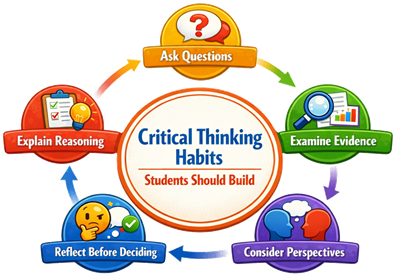
These activities encourage students to explore ideas, evaluate information, and explain their reasoning clearly
When classrooms encourage inquiry and discussion, students develop stronger thinking habits that support lifelong learning
How Parents Can Support Critical Thinking at Home
Parents can encourage critical thinking in simple, everyday ways
Daily conversations and family decisions provide valuable opportunities for children to practice thoughtful thinking.
Some helpful strategies include:
-
Ask open-ended questions:
Instead of yes/no questions, ask “What do you think will happen if…?” -
Encourage explanations:
When children share opinions, invite them to explain why they think that way -
Discuss choices together:
When planning activities or deciding what to cook, involve children in suggesting options and explaining their choices -
Celebrate curiosity:
Praise children when they ask thoughtful questions. It shows they are thinking deeply
By turning everyday conversations into learning opportunities, parents help children become confident and independent thinkers
Conclusion:
Why Critical Thinking Is a Lifelong Student Skill
The benefits of critical thinking show that it is not only a classroom skill but also an essential life skill.
Critical thinking helps students analyse information carefully, make thoughtful decisions, and approach challenges with confidence
As education continues to evolve, developing critical thinking skills will remain one of the most important ways to prepare students for future learning, responsible decision-making, and lifelong success.
By encouraging curiosity, discussion, and thoughtful reasoning both in classrooms and at home, educators and parents can help students develop the skills needed to navigate an increasingly complex world
In a world full of information and choices, critical thinking helps students learn not just what to learn, but how to understand the world around them
