
Why Responsibility and Discipline Matter in School Years?
Aryahi, a Grade 3 student, lives with her grandparents while her parents manage busy professional schedules. Her mother often travels abroad for business, and her father usually returns home late from work. One afternoon, after returning from school, Aryahi found her grandmother had slipped and fallen in the bathroom.
Instead of panicking or crying, Aryahi acted quickly and calmly. She called a neighbour for help, arranged for a doctor to visit the house, and immediately informed her parents about the situation. She stayed with her grandmother and ensured that help arrived on time.
What helped Aryahi respond so responsibly at such a young age?
Her mother had regularly spoken to her about what to do in emergency situations and had encouraged her to think calmly and take practical steps when needed. Because of this guidance, Aryahi was able to act with confidence and responsibility.
This incident raises an important question for all of us:
Are we preparing our children to take responsibility when it truly matters?
Can they make independent decisions when adults are not around?
Do they have the confidence and problem-solving ability to respond to unexpected situations?
If the answer is uncertain, it becomes essential for parents and educators to gradually empower children with these skills. Responsibility, independence, and decision-making do not develop overnight—they are built through everyday experiences, guidance, and trust.
In this blog, we will explore how responsibility and discipline can be nurtured in children from their school years, helping them grow into confident individuals who can think, act, and respond wisely in real-life situations.
The period spent in school is a crucial stage in a child's development. During this time, students not only acquire academic knowledge but also cultivate habits, perspectives, and principles that will define their future. The regular practices they adhere to, the standards they achieve, and the decisions they make within the school environment progressively influence their individuality and conduct
Responsibility and discipline are vital to this developmental process. When students learn to finish assignments promptly, adhere to regulations, and accept the outcomes of their actions, they begin to establish a solid basis for character and autonomy. Self-control and discipline improves their concentration and organization, while the sense of responsibility motivates them to take charge of their learning and behaviour. Eventually, these attributes foster the development of self-discipline and accountability—two fundamental life competencies that facilitate success not just in academics, but also while developing inter-personal relationships, and professional careers.
Understanding Responsibility and Discipline in School Education
When we talk about school aged children, a sense of responsibility refers to their willingness to take ownership of their actions, tasks and commitments. It includes simple tasks like completing homework, engaging actively in the class, following school routines and rules, and respecting peers and teachers. Responsibility for students means awareness about consequences of their actions understanding that their actions participating actively in their learning journey.
Conversely, discipline refers to the structure and consistency that guide students’ behavior. It involves adhering to timetables, respecting classroom conventions, and sustaining focus during educational pursuits. Discipline is not about using punishments when children do not follow rules. It involves providing timely guidance and creating a non-threating environment where students feel free to express themselves.
The significance of discipline in schools lies in offering a consistent structure that helps students in understanding expectations and managing their behaviour responsibly.
Why Responsibility and Discipline Matter During School Years?
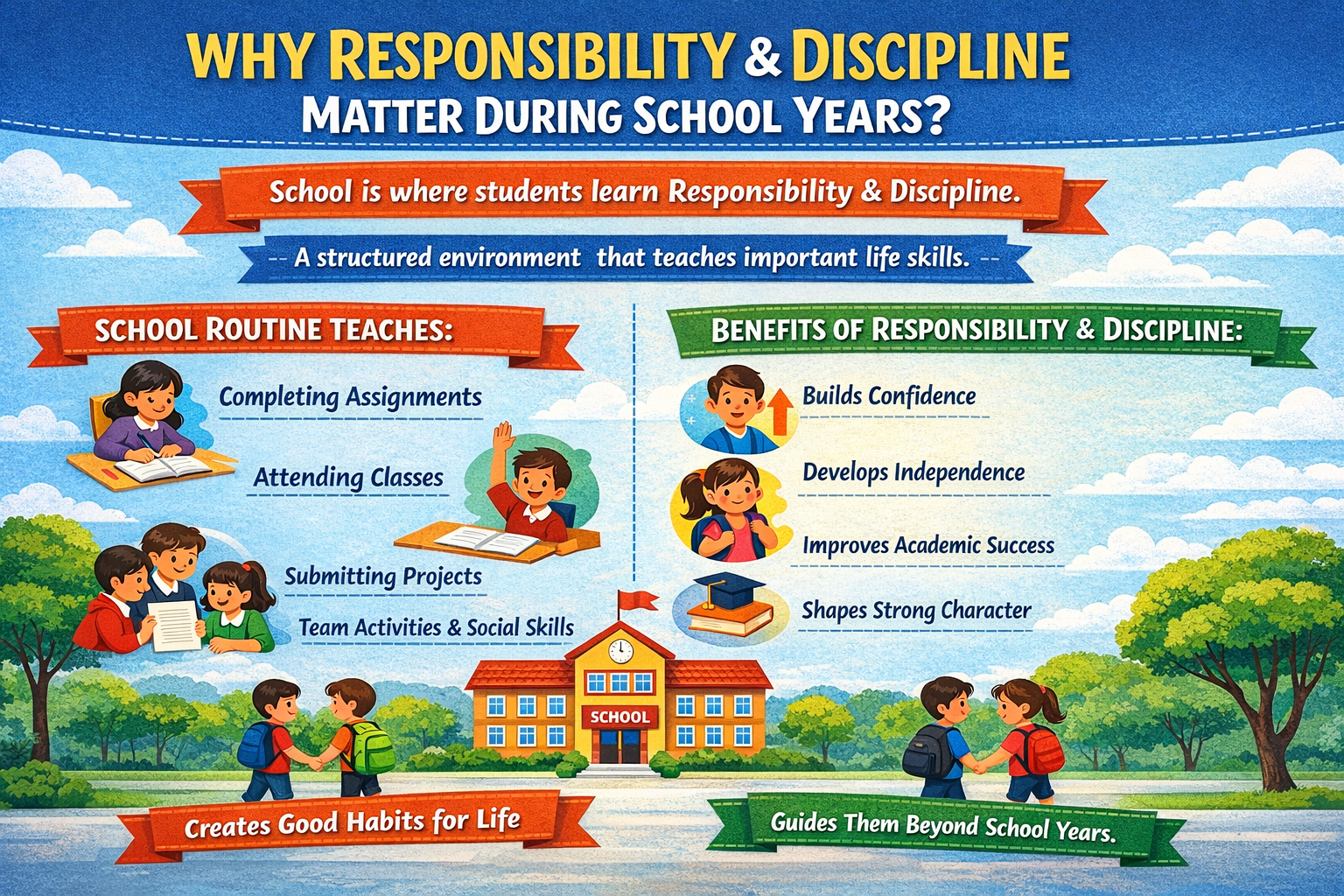
One of the best settings where students learn about responsibility and discipline is the School. This is because schools offer a structured environment different from the informal home environment. The expectations are clearly and consistently communicated to the students. Timetables play a very important role in setting every student’s daily routine, like completing given assignments, attending classes, submitting projects, engaging in the team activities and developing interpersonal bonds. This helps to develop habits which in turn has a positive effect on every child’s academic and personal lives.
Following routines and rules gradually builds confidence and independence. These habits become part of their character and continue to guide them long after their school years are over.
Builds Strong Character and Moral Values
Ever wonder why school rules feel like a character-building adventure? A disciplined school space teaches kids to own their actions, follow guidelines, and grab values like honesty, respect, punctuality, and integrity. It's like levelling up in a game—small steps lead to big wins!
Take Ravi on the playground. While playing cricket, his sixer smashes a classroom window. He immediately admits, "My mistake—sorry!" Honesty lesson learned!
Aryan learns integrity from his team. He forgets his project part, but they do not cover it up—they inform the teacher. Aryan steps up, works late, submits his share, and the whole team celebrates success together
Pooja masters punctuality on a stormy day from her Mom. She calls an auto so they reach school on time—walking might make them late. Now Pooja values everyone's time.
These little hero moments add up, building strong, kind hearts in kids for life's big adventures.
Supports Academic Consistency and Focus
Consider two students preparing for examinations: Raju studies intensively for five hours the night before and receives low marks. In contrast, Tanvi dedicates one hour daily over a month and secures first rank in the class. This illustrates the superiority of consistent effort over sporadic cramming. Raju's teacher informs his mother about the value of regularity. In upcoming examinations, even Raju's performance improves drastically, highlighting the importance of disciplined habits
Discipline in school cultivates consistent study routines and sustained concentration. Students learn effective time management and task prioritization through structured schedules, such as daily revision periods and advance test preparation. This approach enhances comprehension, improves academic performance, and minimizes stress
For instance, Tushar excels in academics while mastering the music and participating in sports. He achieves this through meticulous time allocation: designated slots for musical practice, physical activity, and study sessions. Exposure to diverse skills equips students with the ability to balance multiple responsibilities proficiently.
In summary, disciplined practices promote academic consistency, sharper focus, and superior outcomes.
Importance of Discipline in Schools for Student Development
Schools play a vital role in shaping disciplined behaviour among students. The value of discipline manifests in maintaining classroom order, promoting mutual respect, and enabling teachers to deliver instruction effectively. When students comprehend its significance, they engage more responsibly in their educational journey
For, e.g. If a student like Amit arrives late, the teacher makes him to stand in the class. This rule applies equally to all latecomers, such as Priya, ensuring fairness and emphasizing punctuality.
Upon the teacher's entry or a guest's visit, students stand as a token of respect. They seek permission politely: "May I come in, Teacher?" or "May I go to the toilet?" For absences, students inform the teacher, with parents documenting the reason in the daily diary.
These practices cultivate order, respect, and accountability, equipping students for future challenges.
Encourages Self-Discipline Over External Control
At first, students obey school rules because teachers or parents enforce them. Over time, steady discipline helps them make these rules their own, sparking true self-control.
Psychologist Lawrence Kohlberg described how kids grow morally in stages. In the early "pre-conventional" level, children follow rules simply to avoid scolding—they don't yet understand the difference between right and wrong. With guidance, they move to "conventional" thinking, where they internalize values like respect and duty. Let us take example of little Aryan who shares toys only because the teacher says, "Share or no recess." He does it to avoid a scolding, not because it is fair.
With guidance, kids advance to the conventional stage. Here, they internalize values like respect and duty, following rules to fit in and do what is expected. Maya arrives on time for class, not just to skip detention, but to respect her classmates' time and uphold school pride. This journey turns rule-followers into principled leaders
Promotes Respect for Rules and Authority
A disciplined school teaches kids to honour rules, teachers, and classmates. This builds a happy classroom where everyone learns without chaos. Little Rohan waits for his turn and listens as Priya reads her poem aloud. No interruptions—pure respect in action! Following simple guidelines—like staying quiet during talks or teaming up for art projects—creates teamwork magic.
For e.g. In group work, Sam shares crayons with Lila. They finish a bright poster together, feeling like winners. These habits turn classrooms into respectful, fun spots for growth.
Role of Responsibility in Student Growth
Responsibility for students extends beyond academic tasks. It influences how students approach challenges, interact with others, and make decisions
Responsible students understand that their choices affect not only their own progress but also the classroom environment. Whether it is completing a group project or participating in school activities, taking responsibility helps students become more engaged and motivated learners. For e.g. In a group science fair, Ketan sees his team struggling with the plant poster. Instead of waiting, he researches facts at home, draws clear diagrams, and brings it done early. His effort helps the team win first prize, sparking his love for science. During an outdoor activity, Lila notices kids arguing over slide turns during playground duty. She steps in calmly, sets a quick line-up rule, and ensures that everyone gets a chance to play on slide
Develops Accountability and Decision-Making
When students are encouraged to take responsibility for their actions, they learn the value of accountability. This means recognizing mistakes, understanding consequences, and making better decisions in the future.
For instance, Seema forgets her math homework deadline. Her teacher asks her to think it over. Seema realizes poor planning caused it—Hence, she decides to skip playtime to finish late. She also starts using a daily planner, meets every deadline after, and feels proud of his better choices. This teaches lifelong planning skills. Through this experience, Seema learned the value of accountability. She now uses better planning to achieve consistent success.
Encourages Independence and Confidence
Responsible students gradually become more independent. They learn to organize their work, manage tasks, and solve problems without constant guidance.
This independence builds confidence. A student who successfully completes a challenging project or presentation, for example, gains the belief that they are capable of handling responsibilities and overcoming difficulties
Relationship Between Self-Discipline and Accountability
Self-discipline and accountability go hand in hand. Self-discipline helps students regulate their behaviour, manage distractions, and stay committed to their goals. For e.g. Priya is appearing for her final exam. She turns off her phone, studies one hour daily, and skips extra games. This focus leads to top scores
Accountability on the other hand, ensures that they take ownership of their own actions and outcomes. Forego. Ravi scored low on a quiz. Instead of excuses, he informed his teacher, "I didn't revise enough." He made a study plan and shared his progress, turning weakness into strength.
Together, these qualities form the foundation of responsible behavior. A student who studies regularly demonstrates self-discipline, while a student who acknowledges their mistakes and works to improve demonstrates accountability
Developing both skills during school years prepares students to handle challenges and responsibilities in adulthood
Role of Schools in Nurturing Responsibility and Discipline
Schools play an important role in developing students’ responsibility and discipline through structured learning environments, clear rules, and value-based education. Besides academic learning, schools also focus on character development. Teachers act as role models by demonstrating respect, fairness, punctuality, and consistency, which encourages students to adopt responsible and disciplined behaviour
Classroom activities such as group projects, regular assignments, and daily routines help students learn cooperation, organization, and accountability. By giving students specific responsibilities and clear expectations, schools help them develop time management, self-control, and respect for rules and consequences. E.g. Schools often assign roles such as class monitor, team leader, or house captain. These positions require students to manage tasks, assist teachers, and guide their peers. By performing these responsibilities, students learn accountability, leadership, and the importance of maintaining discipline within a group
Creating a Supportive and Structured Environment
A supportive school environment encourages students to follow discipline willingly rather than out of fear. Clear expectations, consistent rules, and encouragement from teachers help students feel secure and motivated
For example, when teachers appreciate students for completing tasks on time or maintaining classroom order, it reinforces positive behaviour.This encouragement motivates students to remain responsible and inspires others to follow the same disciplined behaviour.
Encouraging Student Participation and Ownership
When students are given opportunities to participate in decision-making, leadership, and daily responsibilities, they develop a stronger sense of ownership toward their learning environment. Instead of being passive learners, students become active contributors who understand the importance of cooperation, accountability, and commitment. Such participation helps them build confidence, leadership qualities, and respect for shared responsibilities. Examples include assigning classroom duties, leading group projects, or participating in student councils. These experiences help students develop leadership skills, teamwork, and a sense of ownership in their learning environment.
Role of Parents in Reinforcing Discipline and Responsibility
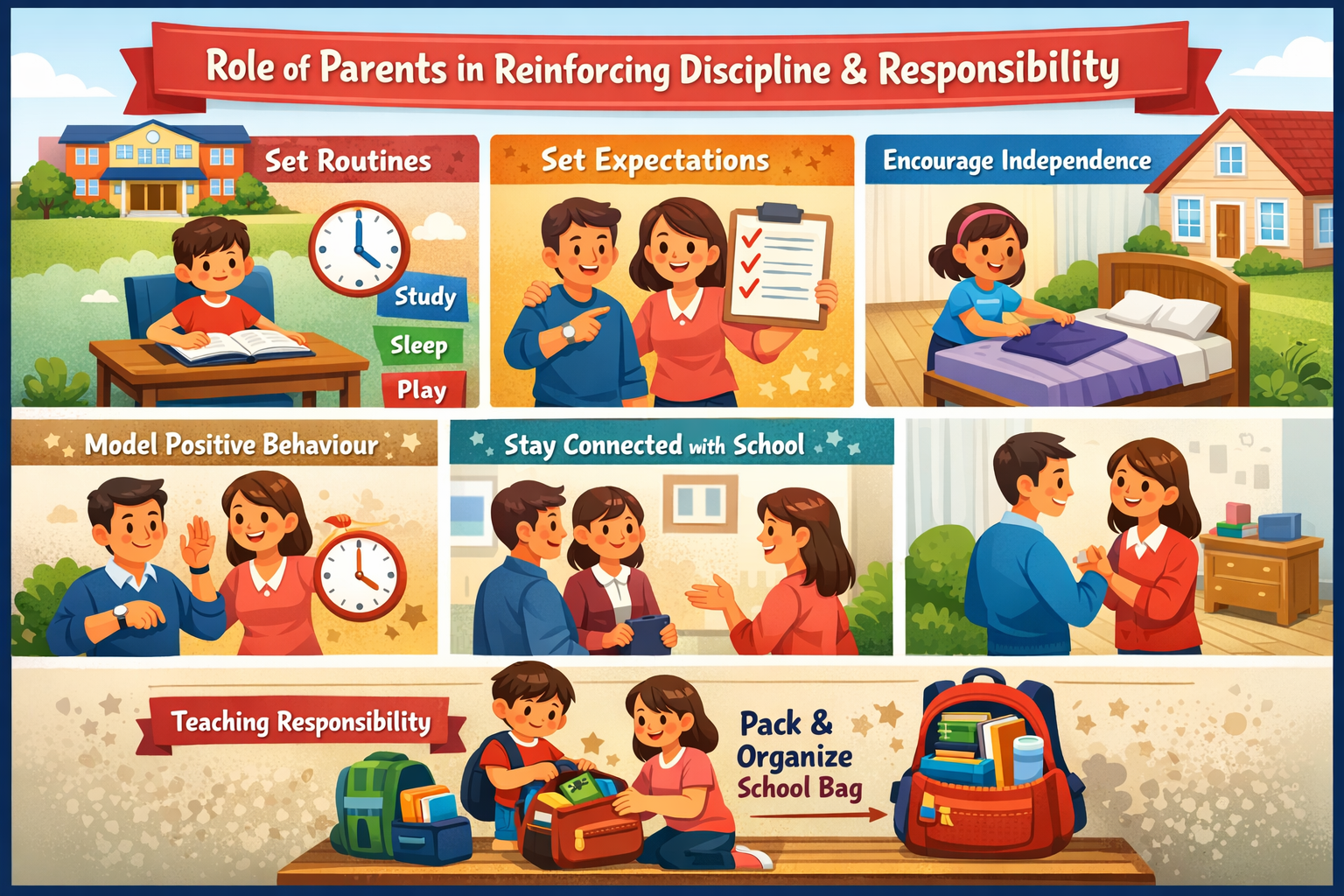
While schools introduce and nurture discipline and responsibility, parents play an equally important role in strengthening these values at home. When children experience consistency between school and home, they are more likely to develop strong habits of responsibility, self-control, and accountability.
Role of Parents:
-
Establish consistent routines:
Set regular schedules for studying, sleeping, and daily activities to help children develop time management and discipline.
-
Set clear expectations:
Communicate simple and achievable rules so children understand what is expected of them.
-
Encourage independence:
Allow children to complete small tasks on their own to build confidence and responsibility
-
Model positive behaviour:
Children often learn by observing adults, so parents should demonstrate discipline, punctuality, and respect in daily life
-
Maintain open communication with the school:
Regular interaction with teachers helps parents stay informed and support the child’s learning and behaviour
E.g.: Parents train their child to pack and organize their school bag every day to make them independent.
Long-Term Impact of Responsibility and Discipline Beyond School
-
Builds strong time-management skills:
Students who learn to follow routines and complete tasks on time develop better time-management habits later in life.
Example: A student who finishes homework on schedule is more likely to meet deadlines in college or at work. -
Encourages accountability:
Responsibility helps students understand that their actions have consequences.
Example: A child who takes responsibility for forgetting a notebook learns to be better prepared the next day. -
Develops goal-oriented behaviour:
Discipline teaches students to stay focused and work steadily toward their goals.
Example: A student who practices daily for a school competition learns persistence and commitment. -
Improves problem-solving and resilience:
Disciplined students are better able to handle challenges and stay motivated during difficult situations.
Example: A child who keeps trying to solve a difficult math problem learns patience and perseverance. -
Strengthens teamwork and relationships:
Responsible behaviour encourages cooperation and respect when working with others.
Example: A student who completes their part in a group project helps the team succeed and builds trust with peers.
Building Responsible and Disciplined Individuals from School Years
Responsibility and discipline are not just school rules—they are essential life skills that shape confident and capable individuals. When students practise these values regularly, they gradually develop habits that support success in learning, relationships, and future responsibilities
Now it’s your turn—Teachers and Parents:
What steps have you taken to build responsibility in children?
Share simple examples from your classroom or home where children practised responsibility
