
Beyond Marks: Understanding Competency-Based Education
Every year, nearly 1 crore Indian students graduate with strong marksheets — but step into a job market that increasingly ignores them. According to the India Skills Report 2024 (Wheebox, CII, AICTE & ETS), only about 51% of Indian youth are considered employable, with employers citing persistent gaps in communication, problem-solving, and the ability to apply knowledge in real-world scenarios. Globally, research from the World Bank and McKinsey mirrors this trend: employers are no longer asking “What did you score?” — they are asking “What can you actually do?”
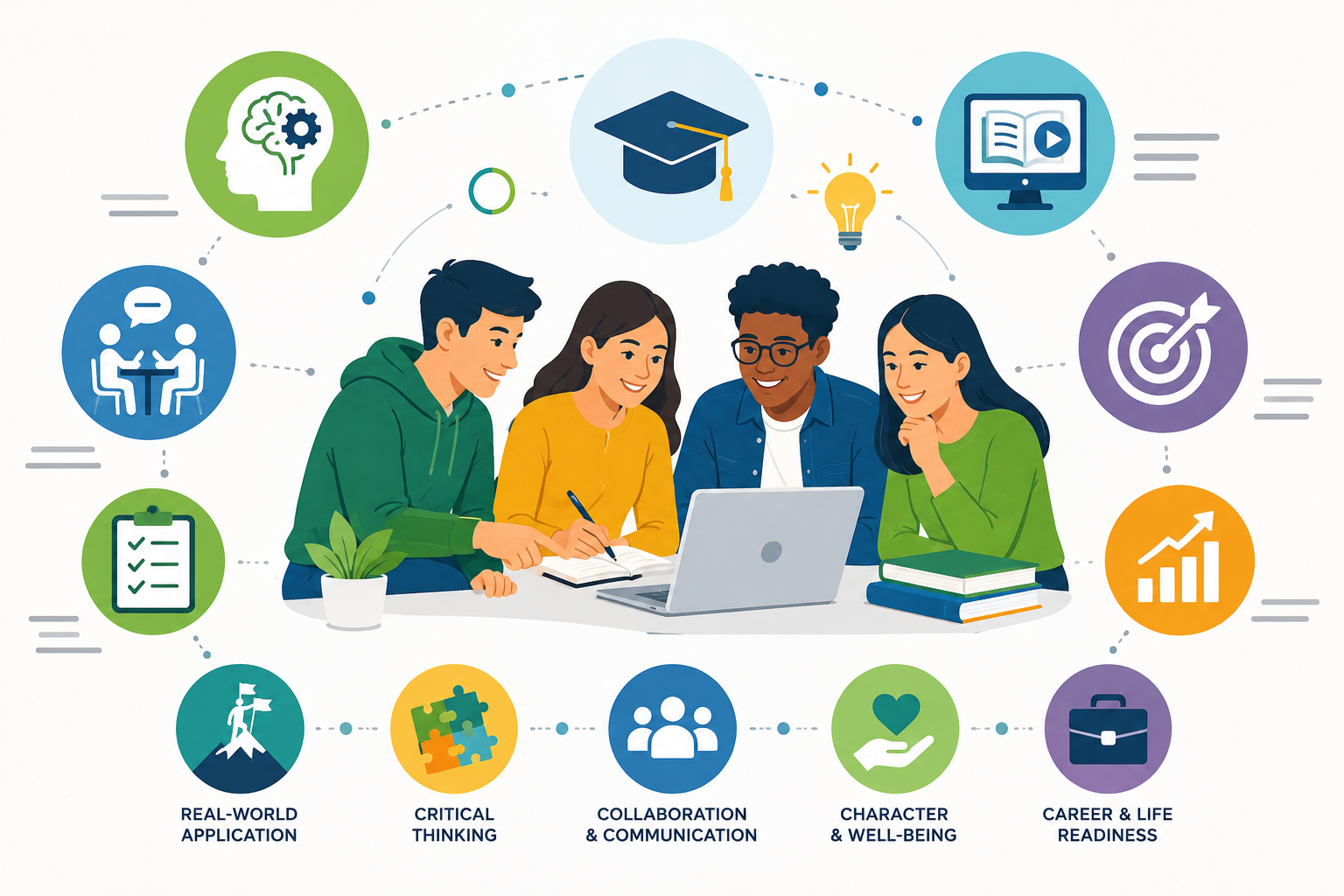
This shift in demand has made competency-based education (CBE) — sometimes called skills-based education — the new benchmark for modern learning. By focusing on demonstrable skills rather than rote memorization, CBE ensures students are prepared for workplaces that value problem-solving, collaboration, creativity, and adaptability over exam scores
Why Competency-Based Education Is Shaping the Future
At its core, competency-based education flips the traditional model of learning. In a conventional classroom, time is fixed and learning is variable: students spend a set number of weeks on a topic, and their understanding is measured at the end through exams or worksheets. CBE reverses this: learning expectations are fixed, but the time to reach mastery is flexible
For example, in a middle-school science classroom:
-
Traditional:
All students take a one-hour test on the water cycle at the end of week three, and grades reflect performance on that single assessment
-
Competency-based:
Students progress through defined competencies — “can explain evaporation and condensation,” “can diagram the cycle correctly,” “can apply the cycle to predict real weather patterns”. A student who struggles with one competency gets additional support, practice, or alternative pathways before moving on, ensuring mastery for all.
CBE is not limited to progressive schools; it underpins India’s competency-based undergraduate medical curriculum, and NEP 2020 emphasizes modular, credit-linked learning with a focus on application over memorization. The goal is clear: Indian education is moving toward what students can demonstrably do, rather than what they can recall for exams
Measuring Understanding Over Memorization
Modern competency-based assessments ask more than recall questions. Instead of “What is Newton’s second law?”, students may be asked to:
Design a simple experiment to demonstrate the law
Predict outcomes when variables change
Justify reasoning and defend conclusions
This approach, often called authentic assessment, mirrors real-world problem-solving and evaluates application, analysis, and critical thinking. Students are assessed against clear rubrics and multiple pathways rather than a single right answer. For teachers, this requires detailed feedback: students need to know which part of their reasoning failed and how to improve, moving learning beyond memorization toward mastery
Every classroom includes students with varied learning styles and paces. CBE accommodates visual, auditory, read/write, and kinesthetic learners, as well as differences in language proficiency and prior knowledge. Flexible pacing, differentiated pathways, and multiple modes of demonstrating learning ensure:
Struggling students get extra support or alternative activities
Advanced students can engage with enrichment tasks
Teachers can identify exact points of difficulty instead of broad “unit struggles”
This approach transforms diversity into a strength, rather than a challenge, and ensures equitable learning opportunities
The Growing Importance of Student-Centered Learning
Student-centered learning places learners at the heart of the educational experience, encouraging active participation rather than passive absorption of content. Key methods include:
- Project-based learning:
Applying knowledge to real problems
- Problem-based learning:
Small groups tackle realistic scenarios
- Inquiry-based learning:
Students investigate questions that interest them
- Self-directed learning:
Students choose what, how, and at what pace to study
These modern teaching methods allow students to experience ownership, reflect critically, and develop autonomy.
Encouraging Ownership of Learning
When students can choose how to demonstrate competencies — through presentations, models, reports, or creative projects — learning becomes personal. This sense of ownership boosts engagement and confidence, making students more invested in outcomes and better prepared for future challenges
Building Independent Thinkers
CBE fosters critical thinking, decision-making, and self-directed learning. By tackling real problems with guidance rather than rote instructions, students learn to navigate uncertainty, analyze evidence, and justify conclusions — essential skills in both higher education and the workplace
Holistic Education and Future-Ready Learners
Holistic education complements CBE by supporting intellectual, emotional, social, and ethical development alongside academics. A student may excel academically, but without skills like communication, collaboration, resilience, or ethical reasoning, real-world readiness remains incomplete
Developing Essential Life Skills
Through structured opportunities in projects, group work, and reflective activities, students practice:
- Communication and collaboration:
Articulating ideas, peer feedback, teamwork
- Leadership and resilience:
Guiding groups, navigating failure
- Empathy and emotional intelligence:
Understanding perspectives and managing emotions
These skills are central to CBE and skills-based education, preparing learners for unpredictable challenges beyond school walls
Creating Well-Rounded Individuals
Schools focusing on holistic development aim to produce students who can apply knowledge, work well with others, and adapt to change, not just memorize content. The combination of CBE and student-centered learning ensures learners emerge as confident, competent, and versatile individuals, ready for life and work in a rapidly changing world
Conclusion: From Marks to Mastery
Competency-based education is not about covering content faster — it’s about teaching what truly matters. By integrating skills-based learning, modern teaching methods, and student-centered, holistic approaches, schools empower students to demonstrate real competencies, not just earn grades. In today’s job market, this shift is no longer optional — it’s essential
