
Montessori vs Traditional Preschools: How to Find the Right Fit for Your Child
“The goal of early childhood education should be to activate the child’s own natural desire to learn.”
– Maria Montessori
There is a growing buzz around preschool curriculum at present. Early childhood education in India is evolving, with the Right to Education (RTE Act, 2009) and National Education Policy, (NEP, 2020) emphasizing on holistic development and parent empowerment. Preschools, or Bal Vatikas, now follow age-based programs under the National Curriculum Framework for the Foundational Stage (2022). The preschool landscape in India now includes a variety of teaching approaches, such as the Montessori method, with emphasis on self-directed activity and hands-on learning; the Reggio Emilia approach, which focuses on exploration and expression; Waldorf education, which highlights imagination and routine; and more traditional or play-based models aligned with the National Curriculum Framework for the Foundational Stage (NCF-FS 2022). Because of this exposure, many caregivers find themselves asking: Montessori vs traditional education—what is right for my child?
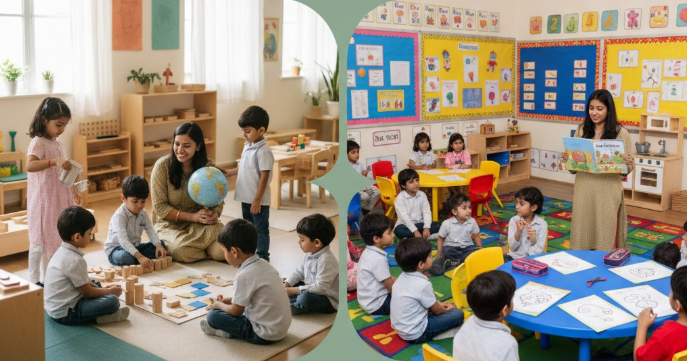
This blog offers a simple, clear comparison of both approaches, focusing on teaching styles, classroom environments, and long-term impact. It will help you in making a confident and informed decision. Now, let us step inside two preschool classrooms and see the difference!
Classroom 1: Montessori Preschool
Founded by Dr. Maria Montessori, an Italian physician and educator, in the early 1900s Montessori education is a method highlighting child-centered learning. It focuses on learning by doing, independence, and self-paced progress. The curriculum is characterized by flexibility. The emphasis is on practical activities that stimulate curiosity and creativity.
In a typical Montessori classroom, there will be children of mixed-age groups learning together. For example, a child aged 4 years and 6 years might work together on a science project, fostering both mentorship and teamwork. The aim of the activities is multisensory stimulation through tactile materials like sandpaper letters and counting beads.
Unlike a conventional teacher who only gives instructions, the Montessori Teacher guides the students by observing each child’s interests and designing activities suitable for their developmental stage. This personalized approach helps children build self-confidence, problem-solving skills, and a love for learning.
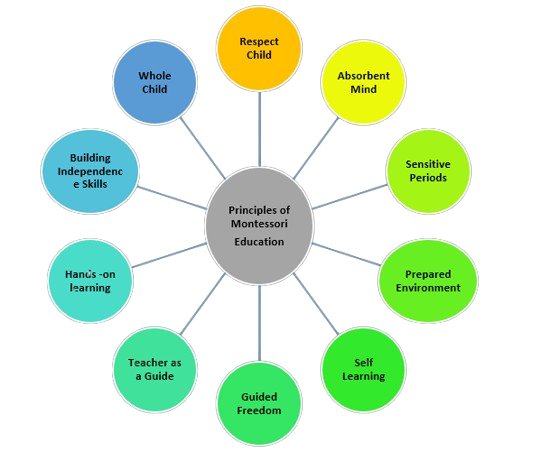
10 Key Principles of the Montessori Method
Montessori vs Traditional: Key Differences
| Aspect | Montessori | Traditional |
|---|---|---|
| Learning Style | Child-led, hands-on | Teacher-led, whole-class |
| Environment | Prepared for independence | Structured, age-based |
| Assessment | Observation & portfolios | Tests, recitation |
| Social Learning | Mixed-age peer interactions | Same-age group activities |
| Focus | Independence, curiosity | Early academics, routine |
First Steps, Many Paths: Which Preschool is Right for Your Child?
Montessori and traditional preschools are not the only options. Understanding the variety of approaches will help us choose what best suits the child’s personality, interests, and learning style.
Western Approaches:
- Play-way Method: Learning through play, storytelling, building, and hands-on activities to build creativity and social skills.
- Project-Based (Reggio Emilia): Child-led projects with art, music, and drama; teachers guide and document learning.
- Waldorf: Emphasizes rhythm, storytelling, and imagination; academics starts after age seven, focusing on creativity and wonder.
Indian Approaches:
- Tagore – Learning with Nature: Outdoor learning through art, music, and nature exploration.
- Gandhi – Nai Talim: Learning by doing—combines academics with practical skills like farming and crafts.
- Krishnamurti – Whole Child Education: Focus on self-awareness, emotional growth, and free thinking.
- Sri Aurobindo – Integral Growth: Holistic development of body, mind, heart, and spirit through meditation, art, and academics.
Hybrid Curricula:
Modern preschools often combine Montessori materials, play-based learning, structured lessons, and Indian philosophies for holistic growth. At Birla Open Minds Pre-school we follow an integrated, thematic curriculum combining Montessori tools, play-based centres, circle time, music, projects, and Indian philosophies like Soul Science to nurture curiosity, creativity, social skills, and holistic growth.
Final Thoughts
Choosing between Montessori vs Traditional education can be tough, as both offer valuable benefits. Montessori nurtures independence and creativity, while traditional schools provide structure and academic focus. The best choice is one that supports your child’s unique way of learning. Now, think about the preschools you have visited—do they feel more child-led, teacher-led, or a mix of both? Do share your observations with us.
