
Must-Have Skills Every Kid Needs for Kindergarten
Entering into a kindergarten is a huge milestone, not just for children, but also for the parents. It’s a kickstart to a brand new chapter or a milestone in terms of academics, social arena and overall growth of a child. As the first day approaches, it’s natural for parents to feel a mix of excitement and a few nerves. You might be asking yourself: Is my child ready? What exactly do they need to know before starting kindergarten?
The acceptable part is that kindergarten readiness isn’t about knowing everything, it’s about conditioning and preparing your child to learn, socialize, explore, collaborate, and adapt. To help ease your mind (and your child’s transition), we’ve created a clear, parent-friendly Kindergarten Readiness Checklist that covers all the essential skills: academic, social, emotional, and physical.
These foundational skills will help your child feel confident, capable, and ready to thrive from day one. Let’s take a closer look at what every soon-to-be kindergartener should be practicing!
Why Kindergarten Readiness Matters
Kindergarten readiness leads to life skills and life readiness, and more over the quality readiness leads to lifelong success. It’s important to note that kindergarten readiness encompasses skills that a child has before they enter their kindergarten classroom that set them up for success. Kindergarten readiness is defined as “certain vital actions /tasks a child should know and be able to do” before they begin kindergarten. Those who exhibit kindergarten readiness in the forms of numeracy and literacy development and social/emotional skills are said to have success in kindergarten and beyond. But where does this kindergarten readiness come from? It mainly comes from home, the way the child is nurtured, from social environment and the parents ofcourse!
1. Physical well-being and motor development.
2. Social and emotional development.
3. Approaches to learning.
4. Language development.
5. Cognition and general knowledge.
Early Literacy Skills
The importance of early literacy development in the kindergarten curriculum cannot be ignored or overruled. It is during these formative years that children’s brains are most receptive to new information and skills. As synaptic connects are stronger during these days. Introducing literacy concepts early on gives children a greater chance of developing a good LSRW in languages. Moreover, strong literacy skills have been linked to better academic performance, improved communication skills and enhanced creative, critical thinking skills. Parents and educators invest in literacy development during kindergarten to provide children with a solid foundation for future educational endeavors.
Early literacy skills enhance the vocabulary bank, phonics, familiar and unfamiliar reading, LSRW, and comprehension skills amongst the children.
Early Math Skills
Children start learning math the moment they start interacting with the world, such as shapes, counting, and additions in a fundamental manner. The early years math skills vary from counting, sequencing, basic shapes, number ordering, patterning, comparing and sorting, measurement, and subtraction through games.
Thinking and Problem-Solving Skills
Raising a kid is no small feat, and it includes patience and to imbibe problem solving skills amongst the students need ample understanding of child dynamics. Students at kindergarten are sensitized with problem solving skills by exposing them to varied puzzles, riddles, and jigsaw puzzles. Consider a situation where your child and his/her friend are playing with a toy car or a puzzle, and all of a sudden, the children get into a quarrel about the toy or the puzzle they are playing with. Such situation arose clearly is because the toy was unequally shared between both. However, it could have been avoided if the children had problem-solving abilities. Instead of quarrelling, the children could have had an understanding of patiently sharing the toy with each other or asked for help from the elders.
Thinking and Problem-Solving Skills
Kindergarteners encourage the students to play and learn with each other, follow directions from teachers, and manage tasks that the students are given. Students, at times, face new challenges, and here, kindergartens assist the students to hone their social-emotional skills with the following activities
- Share and take turns with classmates.
- Use words to express needs and feelings.
- Follow classroom rules and routines.
- Show curiosity and resilience when learning something new.
- Build friendships and work cooperatively in group settings
Following Rules and Instructions
By following classroom rules in kindergarten, children learn to obey elders and make decisions independently. For example, a rule like “Clean up after tummy time” teaches children to take responsibility for their actions with a sense of ownership and responsibility. Over time, they develop the confidence to assess situations and determine the best action.
These rules also encourage critical thinking, collaborative learning, and analytical thinking. Children must evaluate their behavior and adjust to meet the expectations set by the rules. This process strengthens their solution seeking abilities towards problems they encounter while playing or dealing with peers or while studying and prepares them for more complex challenges in the future.
Independence and Responsibility
With the independent work and play at school with varied play items, the child learns to get into independent working, fostering independence and responsibility in children is a crucial aspect of their development. Kindergartens have varied activities that promote independent working amongst the toddlers and make them responsible for their actions, such as keeping the mats at their place once the play activity is over, and making sure there is no clutter while at work.
Physical Kindergarten Readiness Skills
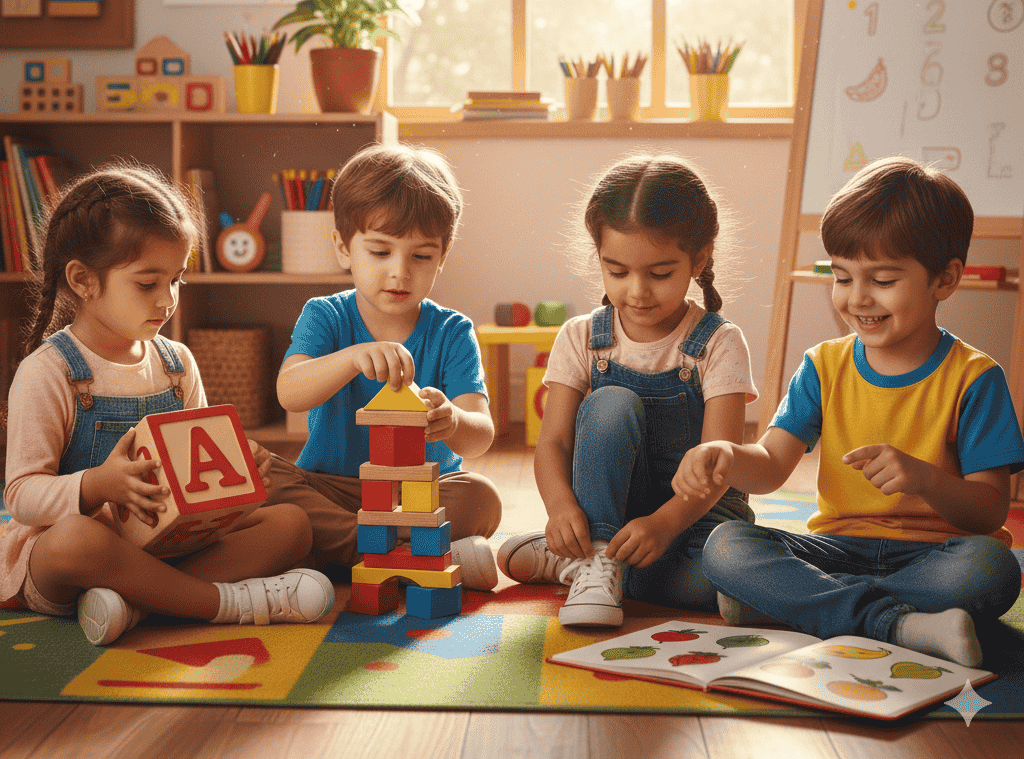
The kindergartens encourage many skills that strengthen a child for the future readiness armed with the desired appreciative inquiry aptitude and attitude in children. The readiness skills such as basic mannerisms, analytical thinking skills, social skills, emotional regulations, cognitive skills and fine motor skills, this is the reason kindergartens have an array of activities in learning spaces such as beading, shoe lace tying, creating towers with blocks, sorting and making a detailed, recognizing colours and cutting with scissors, tearing and sticking paper activities and many more.
Fine Motor Skills
Cover holding a pencil, using scissors, coloring, and managing zippers or buttons. A gamut of activities that encourage fine motor skills is groomed with activities such as paper tearing, using scissors, coloring, buttoning, and unbuttoning with zipping, these activities hone the fine motor skills of the students at a young age.
Gross Motor Skills
1. Indoor Gross motor skills are the activities that involves moving muscles and don’t need a lot of space.
- It is developed through Using furniture, cushions, boxes, and blankets, create obstacle courses.
- Dancing: Dancing with rhymes help in overall grooming of the gross motor skills this is the reason we have a range of dancing activities in the classrooms after regular studies.
- Hopping: Add some excitement to your floor jumping, set up targets using cardboard or masking tape.
- Playing pretend: Children can use their bodies to transform into whatever they can imagine—waddling ducks, stiff-legged robots, galloping horses, soaring aircraft, etc. This can develop their motor abilities.
- Pushing and pulling: Playing with shopping carts, doll strollers, big trucks, or waggons improves upper-body strength and coordination.
2. Outdoor Gross Motor Activities – There is enough space outdoors for kids to play hard and work up their muscles. Help them by suggesting activities for kids such as:
- Balancing: This happens at the playground by making students walk on the low beams or planks or a built balancing beam.
- Climbing, stretching, and reaching: Using rocks, logs, or playground materials, create obstacle courses.
- Riding: Kids should be encouraged to play with ride-on toys such as tricycles and scooters.
- Swimming: From swimming to using sprinklers or water squirters, most children like playing in the water in all forms.
- Playground play: Playgrounds provide kids the chance to run about freely, slide down a steep slide, climb ladders, and pump their legs on swings—often with friends.
- Walking: Go for a walk in the park or the neighbourhood. To make the walk more interesting, use marching, jogging, skipping, hopping, or even musical instruments. Tell tales, count, find colours, or engage in activities as you walk.
- Throwing and catching: Give out big, soft, light balls so that kids may kick, roll, and toss them.
Tips to Support Your Child’s Kindergarten Readiness
1. Attend the Parent Orientation at the school.
2. Understand the Do’s and Don’ts of the school.
3. Get a thorough understanding of the policies of the school.
4. Meet the teacher and have an expectation setting.
5. Do a dry run with your child.
6. Set a consistent routine before the school begins.
7. Train your child on the washroom habits.
Make Learning Fun at Home
Parents are one of the important pillar in the learning of the child at home, for this parents can have joint reading sessions done along with playing educational games, setting daily routines and setting the eating habits, child can be involved in the basic chores of home as it give the child a basic understanding of the social skills, reading bed time stories enhances the reading skills of the students at an early age.
Encourage Independence
We can encourage independence amongst the toddlers by assisting them to set their own bags, chalk out the daily schedule jointly with the parents, asking them to clear the table post meals, dressing themselves, and brushing teeth, choosing their own clothes, and deciding what to eat healthy.
When to Seek Extra Support
Reassure parents that children develop at different paces. Share signs that may suggest a child could benefit from additional support (e.g., persistent difficulty in communication or motor skills). Suggest consulting teachers or child development experts if concerns arise.
Final Thoughts on Kindergarten Readiness
“How well kids do in kindergarten is predictive of academic achievement and higher grades.”
Kindergarten readiness enables children to be successful throughout life. And become balanced global citizens. Early childhood is a key window for acquiring skills that lay the foundation for their school career. Number and letter identification skills, behavioral skills, emotional intelligence, and executive functioning skills should be encouraged at home and in a high- quality Pre-K setting. Making sure a young child’s environment is rich with books, caring interaction, and an appropriate level of autonomy will help them feel confident going into kindergarten.
