
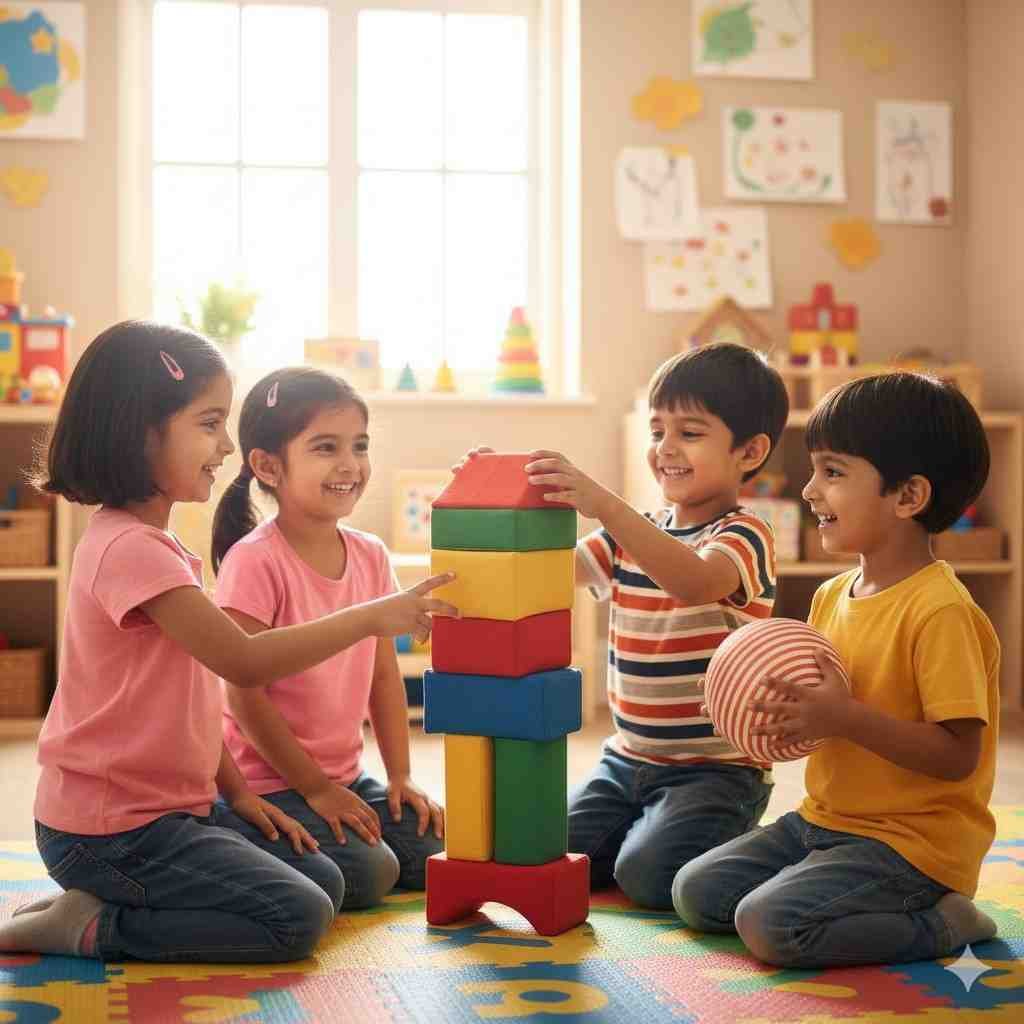
Top 10 Activities to Boost Social Skills for Preschoolers
Instruction: Write a strong opening paragraph introducing why social skills are important for young children. Emphasize that preschool is a key developmental stage where children learn communication, empathy, sharing, and cooperation. Mention that the article will cover 10 effective and fun activities to build these skills. Naturally use the keywords “social skills for preschoolers” and “social skills preschool” in the introduction.
Why Social Skills Matter in Early Childhood
Social skills are just like strong roots of a tree for a child's overall development, enabling them to build relationships, communicate effectively, resolve conflicts, and solve complex social environments with a positive attitude. Strong social skills augment to a strong mental health, academic trajectory, and future career opportunities by fostering empathy, cooperation, and a positive outlook on life. Children learn these essential abilities through interactions with others, providing opportunities for practice and reinforcement. Children learn all these skills by play activities such as sharing of toys, building blocks and solving simple to complex puzzles. Key aspects of social skills such as communication ,empathy, values driven decision, lived experiences are ultimate symbols of the skill development and all these are acquired through learning spaces that are child friendly .
Signs Your Preschooler Is Developing Social Skills
Indicators or meters that reflect learning of social skills are
• Making friends: The child willingly explore making friends and plays with other children, forming friendships.
• Sharing: The child actively shares food, toys, and other resources with friends while at school.
• Resolving conflicts: They can negotiate differences and appreciate others decisions , solve problems, and ask for help when needed, rather than just crying.
• Communication Skills: The child can verbally express their personal needs and emotions to others.
• Active listening: They listen to the teacher attentively and act, express the actions in alignment to the directions they get, these actions itself prove that they have learnt to listen actively.
• Understanding social cues: The child pays attention to nonverbal cues as and when they experience and see them ,this can be from the parents, teachers and their peers.
• Using manners: They use golden words like "please," "thank you," and "excuse me".
• Identifying emotions:The child can recognize and express their own feelings (happiness, sadness, fear) and understand that others have different thoughts and feelings.
• Empathy:They may show empathy by offering comfort, such as a hug, when a peer is sad.
• Independent problem-solving:The child attempts to solve problems on their own or asks for help appropriately.
• Awareness of others:They understand that the world extends beyond themselves and that other people have different perspectives.
Top 10 Activities to Build Social Skills in Preschoolers
Inter weaving learning into everyday activities is a powerful and effective way to make learning of pre schoolers an integral part of your child’s daily life. By blending learning with routine tasks and play, one can build curiosity, creativity, collaboration, global citizenship and a love for knowledge. Here are some effective strategies to integrate learning into everyday activities with your child:
1. Role-Playing Games
Role play is a highly recommended activity that encourages and promotes the development of skills such as respect for professions, appreciate perspective of life and others in their Early Years. It provides them with an opportunity to engage and learn about the world around them in a safe and controlled environment. Enhancing the cognitive domain of the child role plays acts a central tool to process information, role plays weaves emotions to the development of a child thereby adding to a holistic growth of a child.
2. Storytelling and Puppet Shows
Every child remembers a story for the life time and also the morale that story narrates , a stiry is far longer formula as it stirs emotions and often stays etched for the life time , when children watch and hear stories, they build a belief and belief leads to actions and actions leads to behavior , a story is just not a supplement ot learning ,it provides a cultural ,social and ethical development in a child which is as important as literacy and numeracy .
Like a story of monkey and the capseller is etched in all of us and we still follow the learnings from it .
3. Circle Time Discussions
One of the core benefits of circle time is the sense of collaboration and community amongst the pre schoolers,circle time such as collective singing, group activities and sharing their experiences make learning much more effective and etched for years in a child. Circle time enhances the physical activity making the child happy and active through out the day , activities such as dance, singing and playing educational games makes the child learn concepts in a play ful manner.
4. Board Games and Simple Card Games
Board games and card games with pre schoolers develop an important social skill of problem solving , cognitive , social and arithmetic skills , board games such as snakes and ladders with value based coins , the mind, breathing cards makes the child build happiness quotient in them and help build essence of patience . Pre schoolers are encouraged to play such games at school and at home to increase parental association and bonding.
How Parents and Teachers Can Support Social Development
Parents are mainly concerned about their wards development and behaviour , and with strong collaboration between the parents and teachers ,it can build a strong foundation for a pre schooler for his social emotional development , by actions of small reward points on achieving a target or a play help the child build confidence to solve the problems effectively.
Overcoming Common Challenges
Common challenges such as separation anxiety , mixing with peers, establish consistent routines ,set positive expectations can be overcome through varied games and fun based activities along with positive reinforcement and growth mindset with series of smaller baby steps , to overcome socialization challenges the teachers generally make the children talk naturally infront of the peers and make them comfortable, promote peer to peer interactions and free play in the classrooms, these challenges are also overcome through field trips and mystery visitors in the classrooms.
Final Thoughts on Social Skills for Preschoolers
Preschool social skills are crucial for a child’s long-term confidence, growth and mental health, and academic rigour with literacy and numeracy development,, this requires a consistent, playful set and subset of instructions in communication, empathy, and emotional maintenance . Fostering these skills through daily activities and creating a supportive environment helps children build foundational abilities for future relationships and challenges.
