
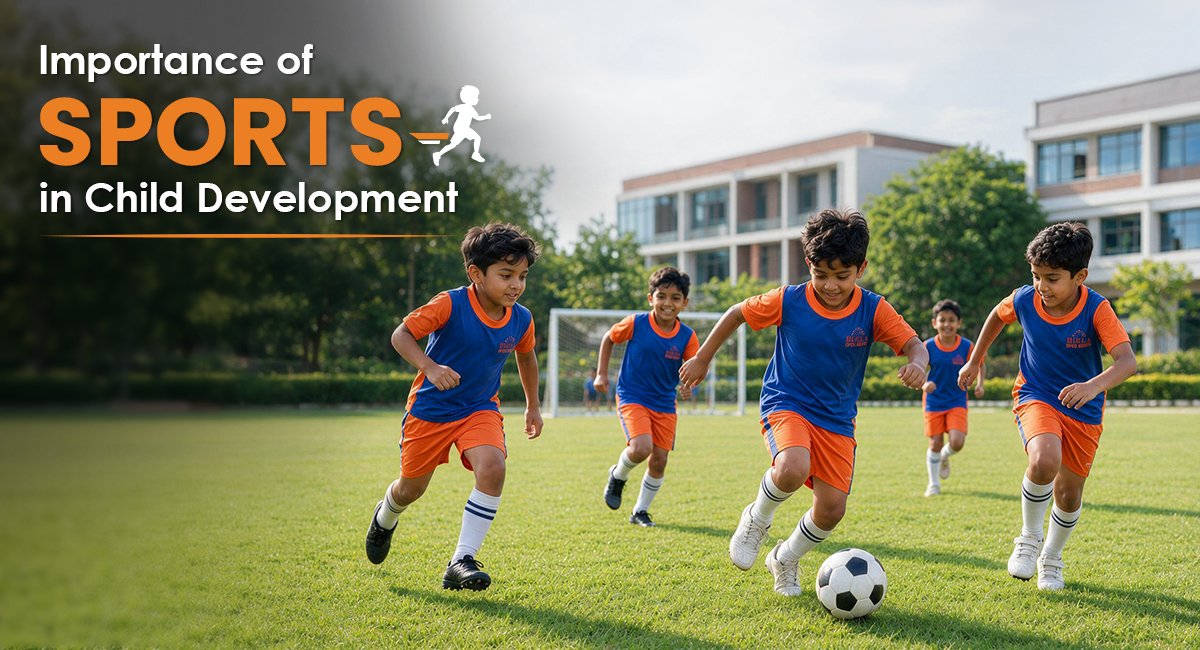
National Sports Day: Importance of Sports in Child Development
Mention the word “khel” (play) to a child and chances are they already have a picture in their head. It could be cricket in the lane, football on the school ground, kho-kho during the games period, badminton in an apartment compound, or simply running around with friends until someone calls them home.
That instinct to play matters more than we sometimes realise.
National Sports Day, celebrated in India on 29 August, gives us a good reason to think about the importance of sports for children. It also reminds parents and teachers that the benefits of sports for kids go far beyond stronger muscles or better stamina. Sport influences how children think, respond to setbacks, make friends, handle emotions and learn to work with others.
And perhaps most importantly, when children enjoy being active, they are far more likely to carry that habit into adult life.
Why Do We Celebrate National Sports Day?
India celebrates National Sports Day on 29 August, the birth anniversary of hockey legend Major Dhyan Chand.
For children, however, the day does not need to be only about remembering great athletes or holding competitions. It can also be an opportunity to ask a much simpler question:
Are our children getting enough opportunities to play?
Between school, homework, tuition, screens and increasingly structured routines, free movement can easily get pushed to the side.
National Sports Day is a useful reminder that physical activity is not time taken away from learning. For children, it is part of learning.
The Importance of Sports for Children Goes Beyond Fitness
Think about what happens during an ordinary game of football.
A child has to watch where other players are moving, decide whether to pass or hold the ball, communicate with teammates, recover when the ball is lost, follow rules, control frustration and keep going even when the other team scores.
All of that is happening while the child is running.
That is why child development through sports is about much more than exercise. Sport places children in situations where the body, brain, emotions and social skills are working together.
The child does not usually think, I am now developing resilience or I am practising decision-making. They are simply playing.
The learning happens along the way.
Sport Helps Build a Stronger, Healthier Body
This is the most obvious benefit, but an important one.
Running, jumping, throwing, catching, stretching and changing direction all help children develop strength, balance, stamina and coordination. Regular physical activity for children also helps make movement a normal part of everyday life rather than something they associate only with a compulsory PE period.
And it does not have to mean expensive coaching or specialised equipment.
Football, cricket and basketball are excellent activities, but so are kho-kho, kabaddi, lagori, skipping, cycling and running games. Even a simple game of catch can get a child moving.
For younger children especially, the aim should not be to turn every activity into formal training. They need opportunities to run, tumble, chase, balance and experiment with movement.
There is another reason this matters: children who discover that movement is enjoyable have a better chance of staying active later in life.
I see this in my own life.
I am middle-aged now, and opportunities to play football are much rarer than they once were. Work, family commitments and everyday responsibilities have a way of taking over. But whenever I do get the chance to play, I still look forward to it.
Not because I am training for anything. Certainly not because anyone is keeping score of my fitness.
I play because I enjoy it.
And even now, those occasional games continue to play a part in keeping me active and fit. That relationship with sport began much earlier in life. It is one reason I believe the real goal with children should not only be to make them exercise. It should be to help them enjoy moving.
If they enjoy it, there is a much better chance they will keep coming back to it.
Sport Gives the Mind a Break Too
Children today deal with a lot of mental noise.
Schoolwork, assessments, notifications, videos, online conversations and constant comparison can make it difficult to truly switch off.
Sport gives the brain something very different to do.
A child chasing a ball is not thinking about ten things at once. At that moment, the ball, the game and the people around them demand their attention.
This kind of physical engagement can help children release stress, improve their mood and return to other tasks feeling refreshed.
Sport also gives children repeated experiences of getting something wrong and trying again.
They miss the goal.
They lose the race.
They drop the catch.
And then the game continues.
Handled well, these small disappointments can teach something valuable: a mistake is uncomfortable, but it is not the end of the world.
Over time, children begin to understand that improvement comes through practice. That lesson can strengthen confidence and resilience in areas far beyond sport.
Children Learn to Deal With Other People
Anyone who has watched children organise their own game knows that sport can become a crash course in human relationships.
Who goes first?
Was that out?
Was it really a foul?
Why does she always get to bat?
Who is going to be goalkeeper?
These moments may seem small, but children are learning to negotiate, communicate and compromise.
Team sports also ask children to think beyond themselves. A talented player eventually learns that keeping the ball all the time does not necessarily help the team. Another child learns that their contribution matters even if they do not score.
Children learn to encourage teammates, listen, take turns, accept decisions and sometimes disagree without ending the relationship.
These are important social and communication skills, and a playground gives children a very real environment in which to practise them.
For teachers, there is value in talking about this after a game.
Instead of asking only, Who won?, we can also ask:
- What did your team do well together?
- Who helped someone else today?
- What could you do differently next time?
Those questions tell children that how they play matters too.
Sport Teaches Discipline Without Making a Speech About Discipline
Some lessons are easier to experience than explain.
A child who wants to improve at badminton discovers that practice matters.
A footballer learns to arrive on time because the team is waiting.
A runner learns that going too fast at the beginning can leave them exhausted at the end.
Children gradually understand that effort, preparation and consistency affect results.
They also learn to follow rules, care for equipment, listen to feedback and manage commitments.
This is a healthier way to think about discipline than simply expecting children to obey instructions. Sport helps them see why habits and responsibility matter.
Winning teaches something too.
So does losing.
The aim is not to protect children from disappointment but to help them experience both success and failure without allowing either one to define them.
A Playground Is Also a Problem-Solving Space
Sport moves quickly.
A child rarely has several minutes to decide what to do next.
Should I pass?
Should I run?
Where should I stand?
What is the other player likely to do?
Children constantly observe, predict, adjust and make decisions during a game.
In kho-kho, they watch movement and timing. In cricket, they judge where the ball may go. In football, they look for open space and teammates. Even a simple relay requires children to think about pace, timing and coordination.
These decisions help develop adaptability and problem-solving.
Adults can strengthen this learning without turning the game into a lesson.
A simple question such as, What could you try differently next time? often does more than giving the child the answer.
Why Schools Need to Take Sport Seriously
Sport should not be treated as something that happens only on Annual Sports Day.
India's National Education Policy has also placed greater emphasis on holistic development and on reducing the old divide between academic learning and activities such as sport, art and physical education.
That thinking is important.
A child who is active, socially connected, emotionally balanced and physically healthy is not taking time away from education. Those qualities support learning.
At Birla Open Minds, this idea of holistic development is central to how we look at education. Across our network of schools in different parts of the country, sport is encouraged not simply as an extracurricular activity, but as one of the many experiences that contribute to a child’s physical, social and emotional growth. Our Head Office, as well as individual school branches, has also built associations with a range of sporting bodies and organisations, creating more opportunities for students to engage with sport in meaningful ways. The intention is not only to identify talented athletes, but to help more children experience the confidence, discipline, teamwork and sheer enjoyment that come from being active.
Good physical education in schools should therefore give children regular opportunities to participate, not only opportunities for the most athletic children to compete.
The child who does not make the school football team still needs to move.
The child who dislikes competitive games may enjoy swimming, yoga, athletics or cycling.
The child who is shy may need time before feeling comfortable in a team activity.
There has to be room for different children to discover different ways of being active.
Parents Can Make Sport Feel Normal
Parents have enormous influence over how children view physical activity.
If sport is spoken about only in terms of winning, trophies and coaching, some children will quickly decide that it is not for them.
Instead, we can make movement part of ordinary family life.
Go for an evening walk.
Play badminton on a Sunday morning.
Kick a football around for twenty minutes.
Take bicycles out together.
Play catch.
Rediscover a game you played as a child and teach it to your children.
It does not need to be elaborate.
It also helps to let children experiment. One child may love cricket. Another may dislike it but happily spend an hour skating. Someone else may enjoy dance more than any conventional sport.
The activity matters. But enjoyment matters too.
Parents can also make a big difference by praising effort rather than outcome.
Instead of only saying, You won!, try:
- You kept going even when it became difficult.
- Your passing has really improved.
- I liked the way you encouraged your teammate.
These are the messages children carry with them.
And when it comes to girls and sport, encouragement must be equal. Girls need the same time, space, equipment and freedom to explore physical activity as boys do.
Screens Are Not the Enemy, but Balance Matters
It is unrealistic to talk about childhood today without talking about screens.
Technology is part of children's lives, and it has many benefits. The problem begins when almost all leisure time becomes sitting time.
Sport offers experiences a screen cannot reproduce fully: physical exertion, spontaneous face-to-face interaction, unpredictable movement, outdoor space and the very particular satisfaction of doing something with your own body.
There is no need to turn this into a battle between screens and sport.
A better question is: Does our child's day have enough movement in it?
If the answer is no, small changes are often easier to sustain than dramatic rules.
A walk after dinner.
Half an hour outside before screen time.
A weekend game.
A regular sport that the child genuinely enjoys.
Consistency matters more than creating a perfect timetable.
For more on this, you can also read about why physical activities are essential for child development.
Celebrating National Sports Day in Schools
National Sports Day does not have to become another elaborate school event.
The best celebrations may actually be the ones that get the largest number of children moving.
Schools could organise:
- short relay races;
- simple obstacle courses;
- yoga or movement sessions;
- traditional games such as kho-kho, kabaddi and lagori;
- cooperative team challenges;
- a try-a-new-sport session;
- running, jumping or skipping challenges;
- mixed-ability games with modified rules;
- short stories or discussions about Major Dhyan Chand and other Indian sportspeople.
Schools can also recognise more than first, second and third place.
- Celebrate the child who kept trying.
- The team that worked well together.
- The student who encouraged another player.
- The child who improved their own previous performance.
That sends a powerful message: sport belongs to everyone, not only to the children who win medals.
The Real Goal Is a Lifelong Relationship With Movement
The importance of sports in child development is not difficult to see once we stop looking only at trophies and scores.
Children move their bodies, but they are also learning to think, cooperate, recover, communicate and make decisions.
They discover what they can do.
They discover what they still need to practise.
And, if we are careful not to take all the fun out of it, they may discover something even more valuable: that being active feels good.
That is the habit worth protecting.
This is also the spirit in which Birla Open Minds schools continue to encourage sport across their campuses. Whether through regular physical education, inter-school opportunities, partnerships with sporting organisations or simply creating more space for children to play, the larger aim remains the same: to make physical activity a natural part of growing up. Because holistic development is not built only in classrooms. Sometimes it happens on a football field, a basketball court, a running track or in an enthusiastic game of kho-kho.
National Sports Day can certainly be a day of races, matches and celebrations. But perhaps its bigger purpose is to remind us of something children already seem to know instinctively.
Sometimes you simply need to get outside and play.
And if that love of khel stays with them long after school is over, we may have given them something far more valuable than a medal.
