
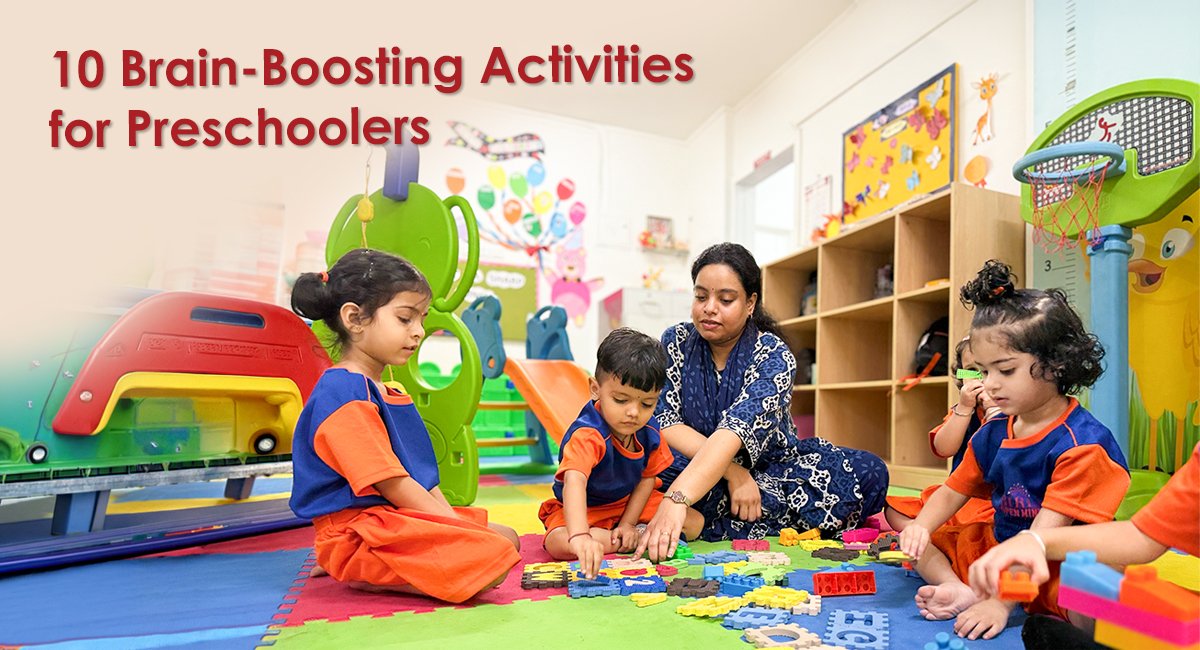
10 Creative Activities That Boost Preschoolers’ Brain Development
Creative activities for pre-schoolers are one of the most powerful tools for early childhood development. The Pre-school years are a critical window where every experience — every game, story, and hands-on exploration — actively shapes how a child thinks, feels, and grows. During this phase, structured yet playful engagement builds neural connections, improves memory, strengthens problem-solving skills, and enhances both emotional and social development.
The good news is that meaningful learning does not require expensive tools or complex setups. This article covers ten practical, easy-to-implement activities that parents and educators can use at home or in Pre-school settings to support healthy, holistic growth.
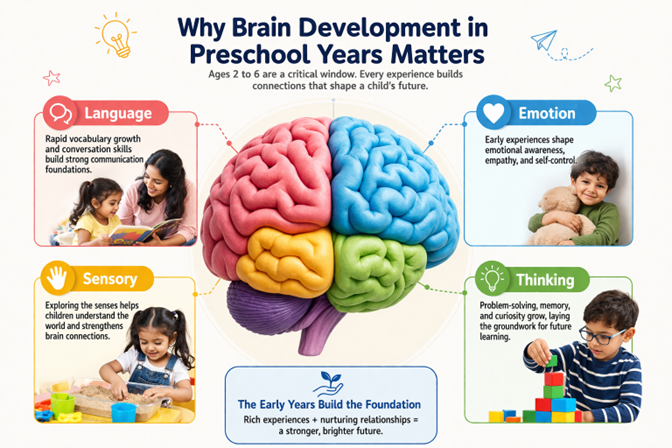
Why Brain Development in Pre-school Years Matters
The ages of 2 to 6 represent one of the most formative periods in human development. During this window, the brain demonstrates remarkable neural plasticity — meaning it is highly responsive to experiences and actively forming connections based on what a child sees, hears, touches, and feels.
This is precisely why brain development activities for pre-schoolers deserve focused attention. At this stage, language is acquired rapidly, sensory experiences shape a child's understanding of the world, emotional awareness begins to take root, and foundational cognitive pathways are being established. According to the Harvard Centre on the Developing Child, early experiences play a defining role in shaping brain architecture and long-term learning outcomes.
Consistent stimulation through purposeful play during these years directly impacts a child's academic readiness and their ability to learn effectively well into the future.
How Creative Play Enhances Cognitive Skills
There is a strong and well-documented connection between creativity and brain function. When children engage in imaginative play, hands-on experimentation, and open-ended exploration, they are doing far more than having fun — they are building the mental frameworks needed for higher-order thinking.
Activities that boost pre-schoolers’ brain development work by strengthening memory and attention, improving reasoning and decision-making, developing cognitive flexibility, and building confidence in exploring new ideas. What makes these activities particularly effective is that they rarely feel like formal learning to a child. The play itself is the lesson, and that natural engagement makes the learning stick.
Creative Play Builds Cognitive Skills


-
Storytelling and Picture Book Exploration
Storytelling is one of the most accessible and impactful activities for early brain development. Reading aloud, discussing pictures, and exploring narratives together help children build vocabulary, sharpen listening skills, and develop a strong imagination.
To make storytelling more interactive and effective, ask predictive questions such as "What do you think happens next?" Encourage children to narrate parts of the story themselves or retell it in their own words after reading. Connecting stories to real-life experiences — for example, linking a story about rain to a recent walk in the garden — deepens comprehension and makes language feel meaningful. These techniques lay a strong foundation for early literacy and communication skills.
-
Sensory Play with Everyday Materials
Sensory play gives children the opportunity to explore the world through touch, smell, sight, and movement. Activities involving sand, water, clay, rice bins, and textured objects are particularly effective at this age.
When children manipulate different materials, they are actively strengthening neural pathways associated with learning and memory. Sensory play also enhances focus and supports fine motor development as children squeeze, pour, mould, and sort. Beyond cognitive benefits, these activities play an important role in emotional regulation — the tactile, repetitive nature of sensory play has a naturally calming effect, helping children manage frustration and build patience. It also nurtures curiosity by encouraging children to ask questions about how things feel, behave, and change.
-
Building Blocks and Construction Play
There is a great deal happening cognitively when a pre-schooler stacks blocks or assembles a simple structure. Construction play enhances spatial awareness, promotes logical thinking, and strengthens hand-eye coordination in meaningful ways.
Children engaged in building naturally encounter trial and error — a tower falls, they figure out why, and they try a different approach. This process of experimentation builds resilience and problem-solving instincts that extend far beyond playtime. Strengthening motor skills through play is also a key benefit of construction-based activities, and building regularly into a child's routine supports both fine and gross motor development.
-
Music, Rhythm, and Action Songs
Music engages multiple regions of the brain simultaneously, making it one of the most holistic activities available for Pre-school-age children. Singing, clapping, dancing, and participating in rhythm-based activities stimulate auditory processing, strengthen memory retention, and support language development.
The repetition built into songs and rhymes helps children recognise patterns in language, which directly supports reading readiness. Rhythm also improves coordination and physical awareness, while musical expression gives children a healthy outlet for emotions. Research from the American Academy of Paediatrics highlights the significant role that interactive, movement-based play has in healthy brain development during early childhood. Action songs in particular are excellent because they combine language, movement, and memory in a single engaging activity.
-
Art and Creative Expression Activities
Art offers pre-schoolers a space to express themselves without the pressure of getting things right. Drawing, painting, colouring, and simple craft projects all contribute meaningfully to a child's development.
From a cognitive standpoint, art enhances imagination and supports decision-making as children choose colours, shapes, and what to create. It also develops fine motor skills through the physical act of drawing, cutting, and moulding. Importantly, the brief should always be open-ended — the goal is expression, not a perfect outcome. When children are free to create without strict instructions, they develop independent thinking and build creative confidence that carries into other areas of learning.
-
Puzzle Solving and Matching Games
Puzzles and matching games are deceptively simple yet highly effective tools for cognitive development. Age- appropriate puzzles improve concentration, strengthen memory, and support pattern recognition — all foundational skills for academic learning.
As children work through a puzzle, they are also developing problem-solving skills and learning to approach challenges methodically. The key is to gradually increase complexity as a child's skills develop, ensuring the activity remains stimulating without becoming overwhelming. Matching games that involve colours, shapes, animals, or everyday objects are an easy and enjoyable way to build these skills at home or in the classroom.
-
Role Play and Pretend Play Activities
When a child plays doctor, runs a pretend shop, or acts as a teacher, they are engaging in one of the most cognitively rich activities available to them. Role play builds empathy by encouraging children to step into someone else's perspective. It strengthens communication skills as they negotiate roles, create dialogue, and build narratives together.
Pretend play also develops social understanding by helping children make sense of relationships, responsibilities, and emotions in a safe, imaginative context. From a cognitive standpoint, these scenarios promote cognitive flexibility — the ability to shift thinking, adapt to new information, and approach problems from different angles. Lev Vygotsky's theories on early learning strongly emphasise the role of imaginative play in developing higher-order thinking and emotional intelligence in young children.
-
Outdoor Exploration and Nature Walks
Taking learning outside offers a richness that indoor environments simply cannot replicate. Outdoor activities stimulate sensory awareness across multiple channels — the feel of grass underfoot, the sound of birds, the sight of clouds shifting overhead.
Nature walks in particular are excellent for observation-based learning. Encourage children to identify different types of plants, notice insects, track weather changes, or collect leaves and compare their shapes and textures. These experiences build curiosity, strengthen scientific thinking, and develop language as children describe what they observe. Physical movement outdoors also plays a crucial role in brain-body coordination, supporting both cognitive development and overall wellbeing.
-
Sorting and Categorisation Games
Sorting and categorisation activities are among the simplest yet most intellectually rewarding games for pre- schoolers. Asking a child to group objects by colour, shape, size, or function strengthens logical reasoning, builds early math skills, and develops analytical thinking.
The beauty of these activities is that they require no special equipment. Everyday household objects work perfectly — sorting spoons and forks, grouping socks by colour, or arranging buttons by size are all effective exercises. These small, informal activities build the kind of systematic thinking that underpins mathematics and science in later years, making them well worth incorporating into daily routines.
-
Simple STEM-Based Experiments
Basic science experiments introduce pre-schoolers to the joy of discovery and the logic of cause and effect. Simple activities such as mixing colours to see what new shades appear, testing which objects float and which sink, or planting seeds and observing their growth over time are all highly engaging and developmentally valuable.
These experiments build curiosity by encouraging children to ask "why" and "what if." They develop foundational scientific thinking by teaching children to observe, predict, and draw simple conclusions. Over time, this habit of questioning and exploring lays the groundwork for deeper learning in science, technology, engineering, and mathematics.
Supporting Kindergarten Readiness Through Creative Activities
Consistent engagement in the activities described above does more than support immediate development — it actively prepares children for the transition into structured classroom learning. Children who regularly participate in creative, hands-on play tend to enter kindergarten with stronger attention spans, more developed communication skills, early numeracy understanding, and a greater sense of independence.
These are precisely the essential readiness skills that complement creative development and help children settle confidently into formal education. The foundation built through play in the Pre-school years becomes the platform on which all future learning is built.
How Parents and Educators Can Create a Brain-Boosting Environment
Creating a stimulating environment does not require a perfectly equipped playroom or a rigid schedule. What matters most is consistency and intentionality.
At home and in Pre-school classrooms, focus on balancing structured activities with ample free play. Limit passive screen time and replace it with activities that require active engagement. Encourage children to ask questions and model curiosity yourself — when a child sees an adult genuinely interested in learning, it reinforces that curiosity is valuable. Provide simple, open-ended materials like blocks, art supplies, and natural objects that allow for creative exploration. Positive reinforcement — celebrating effort rather than outcomes — builds confidence and motivates continued engagement.
Conclusion: Making Creative Learning a Daily Habit
Integrating creative activities for pre-schoolers into everyday routines is one of the most meaningful investments a parent or educator can make. Learning does not need to be formal to be effective — in fact, for young children, the most powerful learning often happens through play, exploration, and creative expression.
When children are consistently encouraged to build, create, imagine, and question, they develop not just skills but a lifelong love of learning. The habits and mind-sets formed in these early years become the foundation for everything that follows — academically, emotionally , and socially. Start small, stay consistent, and trust that every creative moment counts.
