
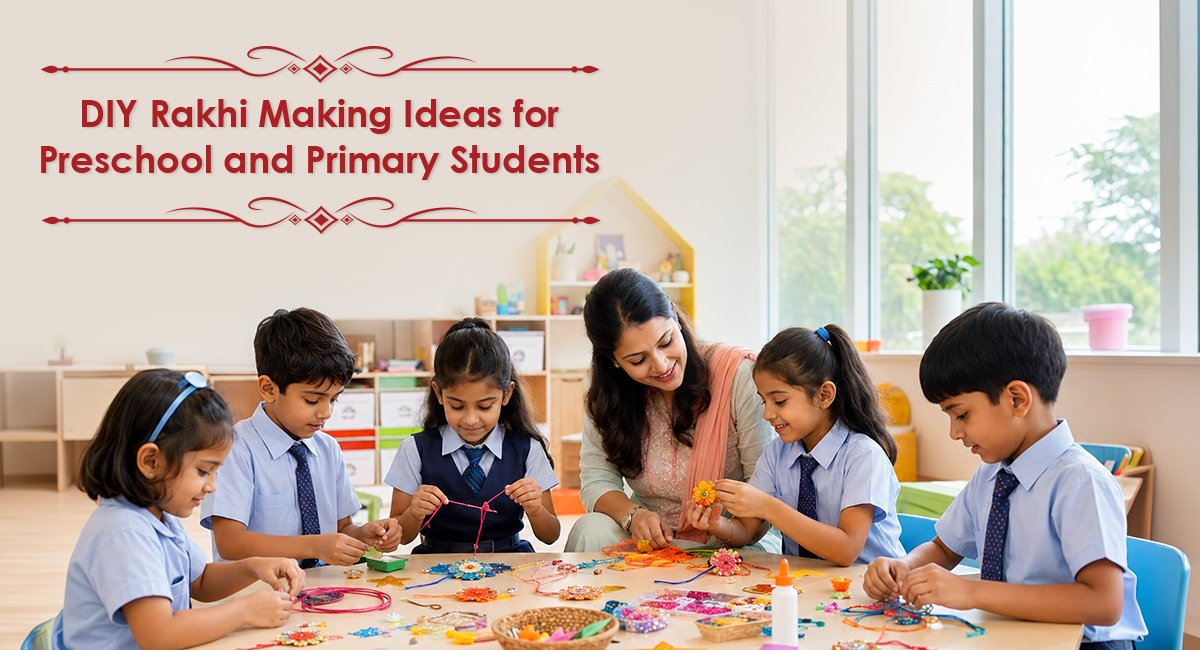
More Than a Thread: DIY Rakhi Making Ideas for Preschool and Primary Students
Every Raksha Bandhan, the same small argument plays out in craft shops: a child wants the Rakhi with the most beads and the most glitter, and a parent quietly wonders whether any of it will mean much to the person wearing it. Worth remembering, then, that the festival's oldest gesture — tying a thread around a wrist — was never really about the thread. Sisters have tied Rakhis on brothers for generations as a mark of protection and affection, and the meaning has only widened since: cousins, friends, and anyone who shows up for a child now sit comfortably within the circle.
A handmade Rakhi restores the balance the shop-bought version quietly erodes. It asks a child to decide what a person is worth remembering for, then translate that into paper, thread, and colour — a far more demanding creative task than it sounds. Along the way come the usual gains of any good craft: fine motor control, sequencing, the small discipline of finishing something. But the real education is in the deciding. A child who has to choose one memory to put inside a Rakhi has done something a shelf of ready-made bracelets never asks of them.
What follows are ten ways to get there — some suited to a preschooler's blunt scissors, others built for a primary schooler ready to write, measure, and plan. None require a steady hand. All require a bit of thought.
Before You Begin
Age dictates more than most parents assume. Preschoolers work best in large gestures — big shapes, thick ribbon, finger-paint. Primary schoolers can hold a plan in their heads long enough to measure, fold, braid, and write, which opens up the more intricate ideas below.
A short list of ground rules, learned the hard way by most crafting parents:
- Non-toxic, child-safe materials, always.
- No beads, sequins, or buttons small enough to choke on.
- Child-safe scissors, adult nearby.
- Check for allergies before flowers, seeds, or pulses enter the picture.
- The finished Rakhi should sit lightly on a wrist — nothing tight or pinching.
- Let the child's choices stand, odd ones included. Symmetry isn't the point.
No Rakhi here needs to look impressive. It needs to have been made, with real attention, by a child who understood — even briefly — why they were making it.
1. Secret-Message Rakhi
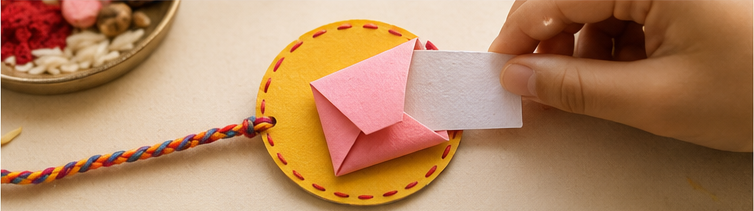
The best-kept ones are the quietest. This design hides a tiny folded note at its centre, unread until the person wearing it decides to look.
You'll need: coloured paper, satin ribbon or soft thread, sketch pens, glue, stickers, child-safe scissors.
Cut a ribbon to fit the recipient's wrist. Fold a small square of paper like a miniature card, decorate the front, and write the message inside before gluing it to the ribbon's centre. A preschooler can manage a drawn heart, with an adult transcribing whatever they say aloud. Older children can write for themselves — "Thank you for helping me," or something plainer, like "I promise to listen to you." The card format forces specificity: not I love you, but a reason.
What Children Learn: Emotional expression, early writing & transcription skills, fine motor precision, and intentful decision making.
2. Plant-Me Seed-Paper Rakhi
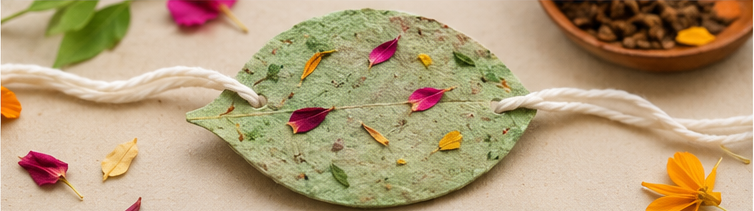
This one doesn't outlive the festival by accident — it's designed to be planted afterward, so the relationship it represents keeps growing.
You'll need: seed paper, soft cotton thread, natural colours, a hole punch, dried flower petals.
Cut the seed paper into a heart, leaf, or flower. Keep decoration light — natural colours and petals only, since glitter and heavy glue will smother the seeds later. Punch a hole on either side, thread cotton through, and once the festival's over, remove the thread and bury the shape in soil.
Preschoolers do well decorating pre-cut shapes with thumbprints or petal presses. Older children can write a short care tag explaining how to plant it.
What Children Learn: Environmental responsibility, eco-friendly crafting, patience, and connection to nature.
3. Two-Halves Puzzle Rakhi
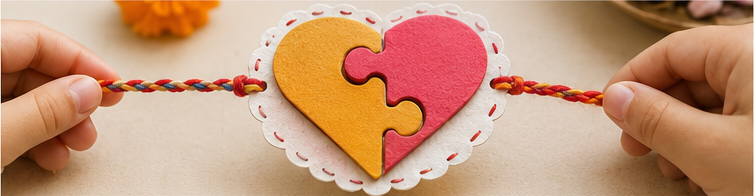
Two Rakhis, worn by two different people, that complete a single picture only when the wrists come together.
You'll need: thick coloured paper or craft foam, ribbon, pencils, colours, scissors, glue.
Draw one large shape — a star, a butterfly, a heart — and split it into two interlocking pieces. Decorate each half so they read as one image when joined, then tie each to its own ribbon. A preschooler manages this well with two matching semicircles forming a sun or a face. A primary schooler can go further, writing one word on each half — care and share, laugh and play — so the join carries meaning as well as shape.
There's something quietly instructive in a design that only works when two people show up.
What Children Learn: Spatial awareness, symmetry, symbolic representation of bond, and collaborative creativity.
4. Story-Bead Rakhi
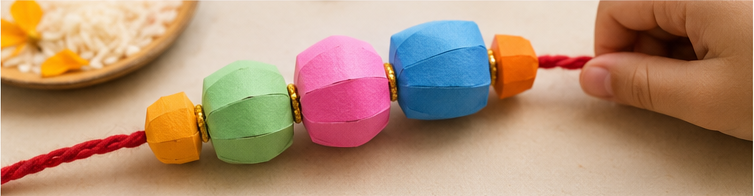
Here, colour does the work of memory. Each bead stands for something specific, and the finished string reads less like a bracelet than a short, wearable diary.
You'll need: large child-safe beads or rolled paper beads, thick elastic thread or ribbon, a small card to record the code.
Choose four or five colours and assign each a meaning — yellow for a happy memory, blue for help given, green for a shared favourite activity, red for love plain and simple, purple for a promise. Thread the beads in that order, pausing at each to talk through what it means, then write the key on a card to travel with the Rakhi. Large beads want supervision; for a preschooler, paper loops make a safer substitute.
The structure gives a child a reason to talk while their hands are busy, which is often when the better conversations happen anyway.
What Children Learn: Sequencing, colour symbolism, storytelling, fine motor coordination, and memory recall.
5. Kindness-Promise Rakhi
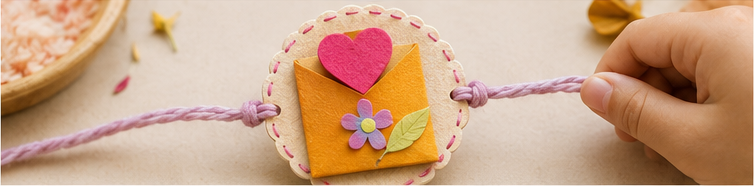
A small, detachable token carrying a single promise — the kind meant to be kept, not just made.
You'll need: ribbon, thick paper, hook-and-loop dots or a tiny paper pocket, crayons, stickers.
Build a comfortable wristband with a small pocket or removable token at its centre. Have the child choose one realistic promise — "I'll share my books," "I'll help tidy our room" — and write or draw it before tucking it away. Steer them away from anything sweeping, like "I'll never fight with you." Grand promises are easy to make and impossible to keep; small, specific ones are the opposite.
What Children Learn: Empathy, setting achievable goals, personal accountability, and meaningful pledge making.
6. Emotion-Wheel Rakhi
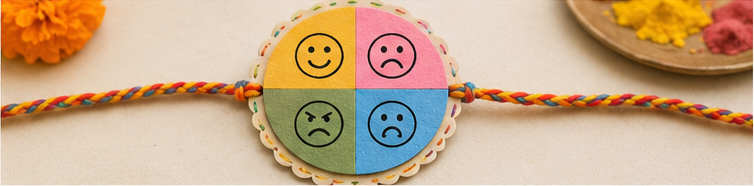
A rotating centre that reveals a different feeling each time it turns — half toy, half invitation.
You'll need: two paper circles, a paper fastener, ribbon, colours, glue, child-safe scissors.
Divide the lower circle into four sections and label each with a feeling — happy, worried, excited, upset. Cut a small window into the upper circle, layer it over the first, and join both with a fastener before attaching the wheel to a ribbon. Turned, it cycles through the feelings one by one; on the back, a line like "You can always tell me how you feel" gives the mechanism its purpose. Preschoolers can trade the words for simple drawn expressions; older children might add a response beside each feeling — "I will listen," "How can I help?"
It's one of the few Rakhis here that keeps working long after the thread comes off.
What Children Learn: Emotional awareness, open communication, mechanical assembly, and empathetic listening.
7. Nature-Texture Rakhi
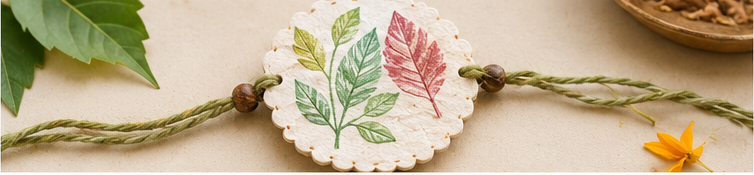
Leaves, bark, and petals leave patterns no craft-store stamp can match — this design borrows them directly.
You'll need: leaves with clear veins, washable paint, recycled paper, cotton thread, glue, crayons.
Paint the underside of a fallen leaf and press it onto recycled paper for a clean print, or lay paper over a leaf and work a crayon across it for a softer rubbing. Once dry, cut the print into shape, thread it with cotton, and add a small circle at the centre with the recipient's initial. Stick to fallen leaves rather than anything freshly picked, and if the finished Rakhi is meant for the compost heap, skip lamination altogether.
What Children Learn: Tactile exploration, organic printmaking, eco-conscious crafting, and appreciating natural textures.
8. Braille-Inspired Name Rakhi
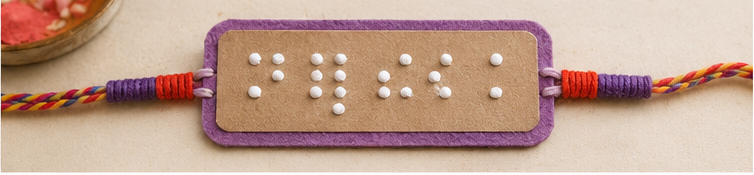
A tactile design, built from a proper reference chart, that opens a real conversation about how differently people read the world.
You'll need: thick paper, glue dots or raised fabric paint, ribbon, a reliable Braille alphabet chart.
Choose the recipient's initial or a short word — joy, care — and use the chart to mark out the correct dot pattern in raised glue or fabric paint. Let it dry completely before attaching the ribbon. Be plain with the explanation: Braille is a tactile system many blind and low-vision people use to read and write, and this craft is an introduction to that, not a substitute for learning it properly. Preschoolers can simply explore matching dot patterns by touch; older children should double-check theirs against the chart first.
What Children Learn: Inclusion awareness, tactile literacy concepts, precision, and appreciating diverse ways of reading.
9. Sensory-Friendly Comfort Rakhi
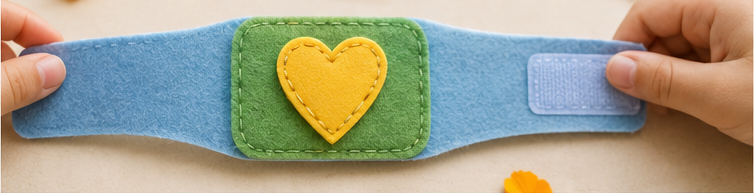
Not every child, or every recipient, wants thread and knots against their skin. This version keeps every design decision in service of comfort first.
You'll need: soft cotton fabric, felt, a broad fabric band, fabric-safe adhesive, a hook-and-loop closure.
Cut a soft fabric band to the recipient's wrist size, rounding the corners so nothing catches. A small felt shape at the centre and a hook-and-loop closure — no knot required — finish the piece. Keep it flat: no dangling pieces, no rough glitter, no metal. Better still, ask beforehand what colours or textures the wearer actually likes. A gift built around someone else's comfort is worth more than one built around your own taste.
What Children Learn: Sensory awareness, thoughtful empathy, tailored crafting, and prioritizing the recipient's comfort.
10. Community Gratitude Rakhi
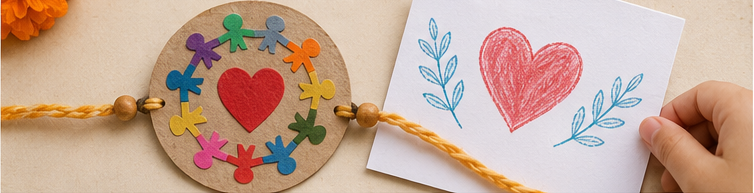
Not every kindness has to flow within a family. This one is aimed outward, at the people who keep a community running without much notice.
You'll need: recycled card, cotton thread, crayons, stickers, a small thank-you note.
Make a simple Rakhi and pair it with a short gratitude card for a teacher, school helper, guard, or healthcare worker. Offer it respectfully, and ask first whether the person is comfortable receiving one; if not, the card stands alone. A line as plain as "Thank you for helping our community" does the job. Frame it as appreciation, not protection.
What Children Learn: Community awareness, civic gratitude, social respect, and extending kindness beyond family.
Which Rakhi Should You Try First?
| If your child loves… | Try this | Time |
|---|---|---|
| Drawing, sharing feelings | Secret-Message Rakhi | 15–20 min |
| Gardening, nature | Plant-Me Seed-Paper | 20–25 min |
| Puzzles, matching | Two-Halves Puzzle | 20–30 min |
| Colours, storytelling | Story-Bead Rakhi | 20–25 min |
| Making promises | Kindness-Promise Rakhi | 20 min |
| Interactive crafts | Emotion-Wheel Rakhi | 25–30 min |
| Printing, textures | Nature-Texture Rakhi | 25–35 min |
| Codes, tactile patterns | Braille-Inspired Rakhi | 25–30 min |
| Soft, simple designs | Sensory-Friendly Rakhi | 20–30 min |
| Thanking others | Community Gratitude Rakhi | 20–25 min |
Make It a Family Moment, Not Just a Craft
A Rakhi means more to a child when they've had to account for it — so resist the urge to fix an uneven line, and ask instead:
- Why did you choose these colours?
- What does this Rakhi say about the person it's for?
- What part was difficult, and how did you get past it?
- What small act of kindness could travel with it?
Photograph each child with what they've made, and note the story behind it. Kept up over the years, that record becomes something closer to a family archive than a craft folder.
Keep It Inclusive
Not every household has the shape a Rakhi advert assumes. A cousin, a friend, a grandparent, a caregiver — any person a child trusts is reason enough. No child should be made to tie one, receive one, or offer a promise before they're ready to mean it. Willingness is most of what makes the gesture worth anything.
Celebrate the Effort, Not the Perfection
The best Rakhi on a craft table is rarely the neatest. It's the one that let a child say something true, however unevenly it was glued together.
These ten ideas ask more of a child than copying a sample — a decision, a memory, sometimes a promise that will need keeping. Whichever one your family lands on, the object itself is almost beside the point. What matters is the hour spent making it, together, in service of someone else.
So this Raksha Bandhan, let the Rakhi carry something better than glitter: a memory, a feeling, a thank-you, or a small, keepable promise.
